
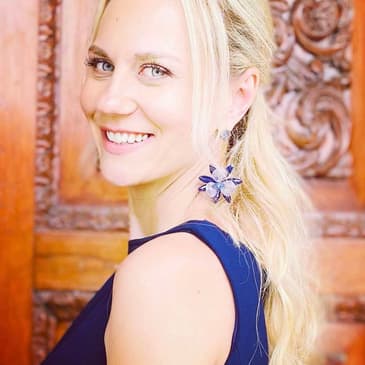
Irina Crigan is a Finance Professional with more than ten years of experience in the asset management space. She’s extremely passionate about personal growth and human transformation. She is also a speaker and a fierce advocate for Transformational Leadership. Irina is also advocating for a world where youth should pursue their journey of self-discovery and growth and integrate leadership skill sets early on in their life journeys.
Welcome to SpeakUP! International with Rita Burke and Elton Brown!
Rita Burke:It certainly gives me great pleasure and delight to introduce our guest today, and her name is Irina Crigan. Now Irina is a finance professional with more than 10 years of experience in the asset management space. She's extremely passionate about personal growth and human transformation. She's also a speaker and a fierce advocate for transformational leadership. Irena is also advocating for a world where youth should pursue their journey of self-discovery and growth, as well as integrate leadership skill sets early in their life's journey. I introduced to our audience today, Irena Crigan!
Irina Crigan:Thank you so much, Rita and Elton. I'm so excited to be here. Thank you so much for inviting me.
Elton Brown:Before the actual conversation started, you were talking about this group Beacon of Youth, which you are a part of, can you give us a little bit information about that group?
Irina Crigan:Absolutely. Okay. So first of all, maybe I can take you to where it all started. And I have to mention that my own transformational journey started back in 2020. And this is exactly when the pandemic has hit. And I remember, and I share this story a lot, I remember actually going through the newsfeed of LinkedIn, which is the professional network, and I came across a past by post, by Ariana Huffington that said the following thing. and just imagine it was the beginning of the pandemic. We didn't know how the virus mutated, what was happening. They didn't really know if we had to keep any distances between us. So it said the following if you can't go outside, because again, we were in the context of being afraid to go outside, we were fighting the virus. It said the following,"if you can't go outside, go inside" and I don't know, my daughter was turning one at the time and I've had this introspection and we were given this amount of extra time in our lives and I've taken this time to really go, dig, deep within and find certain answers that I've been, I guess looking for 30 plus years. So this is how my transformational journey has started peeling the layers of the onion, and sometimes not finding the most pleasant things, have led me to be part of different communities on LinkedIn. People I reached out to for help, this is how I met my coaches, my mentors, and uh, eventually the community I'm part of. To answer your question, Elton, is the Beacons of Leadership and this year I was recognized as the beacon of tomorrow's youth. Due to the fact that I have a mission to go out there and empower youth to to get ready, prepared to lead in their future workplaces. So my only regret is having started this journey of transformation so late that I believe that, and I do believe in the importance of starting it early. That's why I say youth, are in the, are in their formative years when this is extremely foundational and important to do as a work.
Rita Burke:That is so accurate. It's a good time to get people when they're in their youth so that you can mold and massage and encourage them to become what it is you want them to arrive at for their lives. Now I'm really curious to find out, I know you talked about 2020 and hearing about going inside. If you can't go. Tell us about the inspiration. I suspect this was a bit of an inspiration, more of an inspiration for your interest in transformational leadership. Please.
Irina Crigan:What is the link with the interest with transformational leadership? Yeah, that is correct. Very good. Okay. So I knew I had to make changes within me because for 30 plus years I've been, I guess living a life in an execution mode, basically like on autopilot mode with high anxiety levels, very low. self esteem and self-confidence. I was carrying somebody's else's values and beliefs. My suitcase was quite heavy, so I needed to unpack that and the journey started with the self cognizance exercises, you and getting the expert help to get to know who I am before I could actually be able to guide, and help others to do the same. And for me, it's a way of giving back to the community, it's paying forward because I had this woman who's today my mentor, and if she's listening, I'd like to say hi. Her name is Linda Tillson, a lady I've met in one of the communities I was part of in 2020 that literally has spent six months of her life every week scheduling calls with me and holding a space for me to grow. I thought I was not good enough at the time. She believed in me before. I believed in myself and truly hold, held for me this container that allowed me to build the self-confidence and move into the next stages of human development. So for me, it's like giving it back to the community, to the youth and even to the workplace I'm part of.
Elton Brown:That's a wonderful. So your transformational leadership was through mentorship, if I got this correct.
Irina Crigan:Correct.
Elton Brown:What system are you using as a transformational leader to empower the youth and what are the ages of these youth?
Irina Crigan:Yeah, great question. So basically I'm working right now in a curriculum and how we could bring this into schools. I have started a project with my home country. I'm originally from Moldova. I actually moved to Canada back in 2010. So it's been 12 years now. And one of the projects I had, I let a workshop this last year in 2022 in one of the private international schools back in Moldova. I partnered actually with my mentor because I thought she would be the great, partner to to be able to do it collectively with, and we went in one of the schools out there and we had a conversation actually with the students of what they can do today to prepare for their future workplaces. And I believe what we're missing out there is sometimes, there's a lot of theory a lot of keynote speakers come with PowerPoint slides and they get a one maybe to teach them something. If, for us it was more of a pragmatic experience with the students. We wanted to get to know them better, to create those safe spaces for them to speak up of what is important to them and how they view themselves coming into the workplaces. To me it's like sometimes, what does leadership look like on a Monday morning at 9:00 AM when deadlines are tight and maybe there is some pressure or tension that is building up in the room that people are sitting, you know, across the table and, and they're facing each other. What does leadership really look like? Then
Rita Burke:Thank you for that answer because you're asking, you were asking what does leadership really look like? So in your view, in your work environment, in your work, Mel, you in your work setting, what does leadership really look like, and maybe not just leadership, effective leadership, which I suspect ties into the whole concept of transformational leadership. What does it look like?
Irina Crigan:I'm so privileged because it should be the normality. As I've mentioned in the speech that I've given a couple of weeks ago, Rita, I think we should. Like it's logical that we want to build healthy industries, businesses, societies with healthy individuals. But the truth is that the majority of how businesses and work cultures are operated today are quite dysfunctional, I think. I don't know how about you, but I've tasted from dysfunctionality and toxicity and that it hasn't. Really good. So I am privileged today to be part of an amazing work culture where people show up as their authentic selves. We're, let's say we're in spaces where we feel safe that we can show up like that actually. And, and bring our unique talents and gifts and exchange with the rest of the team. So this is how it looks like. I feel like we're cared for, we matter, and we're making a difference and we're part of the mission and the vision of the company.
Elton Brown:There are so many types of leadership. There's transformational leadership and then there's servant leadership. How do you feel about those two styles of leadership and is there a way that transformational and servant leadership can be merged?
Irina Crigan:Again I don't know the etymology necessarily of servant leadership, but I believe the fine is, the line is so fine that I feel like the servant leadership approach is actually part of the transformational leadership. A notion that emerges actually somewhere in the, if we research at the end of the seventies. But there's so many things that are in common about a leader that shows up every single. Wearing their coaching or mentor hat, or speaking of mentorship earlier. And I believe as the leader that is capable of empowering their employees. So I often use this example, and I'm a huge fan of Bob Chapman work Cultures and I don't know if you're familiar with his book. It's everybody Matters and Simon Sinek as well, that yeah, that speaks about leadership and they compare actually leadership to parenthood. You are willing to hold your toddler's hand, not enable them. You wanna empower them. You wanna show them the way, you wanna show them the vision. What is possible out there in the world. I do see it in the same manner for transformational or servant leaders. They're the ones that are willing to hold the hand of their people, of their employees, but at the same time is while, patiently holding their hand in their, in the spaces. They'll know exactly when to nudge and say, Hey, I think you're ready. I'll just push you a little bit from behind. Go and do this. Now you're capable. You can do this. So I think it's a perfect balance between the two.
Elton Brown:Just wanna step back just a teeny, teeny bit, and this is going back to empowering the youth. When, how do you create a safe place for youth? This is the middle of COVID we're not seeing anybody everyone's staying at home. How were you able to create a safe place using Zoom for these youth, that were being transformed by you?
Irina Crigan:Yeah, it was Zoom call. Sometimes they say that you lose maybe a part of the connection through a Zoom call. I don't think so. Zoom has brought us closer and has shown us this different ways of connecting with each other. That's why I said this workshop that we've done was about listening to them, giving them the opportunity to express themselves. And we've learned pretty amazing things about them. Those young kids are doing amazing things. They're volunteering out there in the world. They're making a difference in their communities. And they even, some of them even have some side gigs they're trying to build on, on, on the side and it's just amazing how by listening to them, you. a lot about them because I know we have the tendency of saying, oh, this new generation is the social media generation. They are disengaged. They don't wanna talk on the phone, they just wanna text. I was reading some statistics the other day. The Gen Z one want actually direct exposure to the senior executives. Same thing with the millennials, the workforce that is taking over in the following years in the US and Canada and everywhere, pretty much they're replacing the boomers. These are people that want direct exposure to the senior executives. They no longer respond to that authoritarian type of leadership where you have to respect some kind of hierarchy.
Rita Burke:You, you're obviously you told us in your bio that you were passion. about helping you to develop their skills to be transformational leaders, and I can feel it oozing out of everything that you say. I am really fascinated with that fact. Now you are talking about youth, but where do you get your youth from? How is your community made up? Where are there, how do you get to meet these youth that you work with?
Irina Crigan:Yeah, so I reached out last year to a school director, an amazing leader. That is a principal of an international private school. I said, I reached out back to my colleagues in my home country. By the way, I have studied foreign languages. For quite a while before I moved to Canada, I worked as a teacher at one of the schools back in Moldova. So I reached out to those colleagues of mine that are already actually heads of. Global education and training. They're doing this amazing job as educators on the field and I said, Hey, let's partner. Let's do this amazing thing. I think you are doing an amazing thing in your field, but I feel like we can come with this new perspective and partner together and do this work. So this is how this first workshop actually happened, is by reaching out and seeing how we can bring even more value altogether, because it's true for this many years, I haven't been an educator. They're the educators, but then we have the pragmatic aspect of what it what it is to work actually in the corporate world for 10 plus years and just, share this experience out there.
Elton Brown:Wow! What languages do you speak?
Irina Crigan:I speak Elton five foreign languages. It's English, French, Spanish. My mother tongue is Romanian and I also speak Russian.
Elton Brown:Wow. That is truly amazing. When you think of a transformational leader, who comes to mind?
Irina Crigan:My mentor. Can I say this?
Elton Brown:Yes.
Irina Crigan:This amazing woman, my mentor that has transformed my entire existence. And that continuously. Why Continuously inviting me to step out of my comfort zone. nothing panicky, but she always says one foot in the comfort zone, one foot in the un-comfort zone, and that's how we grow and we take it to the next levels.
Rita Burke:I'm sure she would be delighted to hear how you're complimenting and begging her up. She must be doing a marvelous job with. I have a question. Yes. And this question forces you to think outside of the box a little bit, and here we go. If you were to have the opportunity to write anything that you could on a huge billboard, what would you write in that billboard so that millions of people could see it? What would you write?
Irina Crigan:I'd say committed to growth. This is what I put out there in the world, committed to growth.
Rita Burke:That you are committed to growth and you want everyone to become committed to growth as well, particularly.
Irina Crigan:Yeah. Yeah. It's funny you asked this question, Rita, because yes, I'm committed to growth and I'd love for others to be committed to. But I realize sometimes that my end goal is not to convert people. I want them to understand that I want them to eventually do it because they wanna do it. I don't want them to do it for the wrong reasons. I'm a perfectionist and I might say, okay, it's good to grow. You have to grow because, it, there's so many advantages to their growth and I have the tendency of want to focus more on the end rather than the process. Hence, I realize sometimes I do want to convert people, to that growth, which what I realized above myself is that, you'll have you don't have to force anything. I hope people come to the conclusion that it's good for them to grow, but definitely if I talk about myself, I'm committed to my own growth.
Elton Brown:That's about all anyone I think can do. You can, take a horse to the water, you to the horse to actually drink.
Irina Crigan:I love this Elton!
Elton Brown:From the from the stream. That's the only way it can work. So as a transformational leader, how do you get, or what strategy do you use that get the most out of your youth, the youth that you're training?
Irina Crigan:I'm working a lot on myself. And, again, the, there, there's no it's a constant continuous journey. I have so many insights and breakthroughs as I move along the way. And I haven't seen this, it's been in my blind, but I haven't seen this, is just, I think being open. About it sometimes what I realize about myself, because for 30 plus years, by the way, I've been a very maladaptive perfectionist. That has worked really hard to come into more adaptive states. And I know sometimes, and it's getting vulnerable outta here. Sometimes I go to some default modes which is logical. My brain like would learn new things. But then sometimes I, one of my default states, for instance, is being defensive, I think knowing that is power, knowing what your weaknesses are, what your limitations are, what your strengths are. But as well, when we talk about growing others, is knowing their defaults as well. Because if you want them to embark in change, you need to know where they situate themselves. Are they the other extreme of the change? Are they pre contemplating or somewhere trying to embrace the change? So I'm not sure Elton, if I derailed a little bit, but
Elton Brown:No that's just fine. This conversation is all about getting, to know you, Rita?
Rita Burke:Yes. Irena, you're really. boggling my mind at what you're presenting, the concepts, the ideas, but most important of all is your passion. It's genuine, it's authentic, and I certainly appreciate that. The one thing that resonates with me, there's so many things that resonate with me that you've said so far, but is"if you can't go outside, go inside." I will never forget that statement because it is so accurate and so through. And as a matter of fact, before you go outside, you need to be able to begin by going inside. So it's about reflection, it's about introspection and all of those wonderful things that we hear from the experts. So I certainly appreciate you're joining us today and being so open and so vulnerable in sharing your story. So thank you again. Thank you. Thank you so much for joining us today on SpeakUP! International.
Irina Crigan:Thank you so much. That was a blast. Thank you to both of you!
Elton Brown:Thank you for listening to SpeakUP! International. For more information about our guests, Irina Crigan and her professional services. Please send your inquiries to irinacrigan@gmail.com. If you would like to have a conversation with us at SpeakUP! International. Please drop us a message containing your name, company, name and email address to info@speakuppodcast.ca. To connect to our podcast using Spotify or your favorite podcast platform, search for SpeakUP! International. You can also find our podcasts using our web address, www.speakuppodcast.ca. Our logo has the woman with her finger pointing up mouth open, speaking up!