
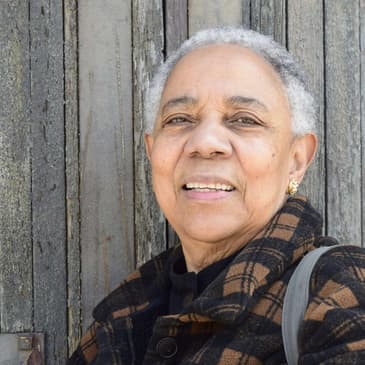
Meet the luminary, the innovator, the trailblazer - Lillian Allen. A true renaissance soul, Lillian wears many hats with remarkable grace. As a revered educator, she imparts her wisdom as a professor of creative writing at Ontario College of Art and Design University (OCAD). But her influence goes beyond the classroom walls.
Recipient of not one but two prestigious JUNO Awards, Lillian Allen's impact on the world of spoken word and dub poetry is immeasurable. She has sculpted her art form into a vehicle of social commentary, seamlessly weaving the past and the present to create something wholly unique. Through her mastery, she explores the vibrant tapestry of music's old and new sounds, fusing them into a cutting-edge brand of Canadian reggae infused with global influences.
From her latest single, "Woken & Unbroken" (2018) to the groundbreaking album "ANXIETY" (2012), Lillian's powerful reggae dub poetry and spoken word recordings resonate with a depth that leaves an indelible mark on the soul. Let's not forget her revolutionary debut solo album that clinched the Juno Award, the emblem of excellence in Canadian music - "Revolutionary Tea Party."
Join us in this episode as we unravel the layers of Lillian Allen's artistry, exploring how she breathes life into her verses, crafting a symphony of emotions and insights. Get ready to be enchanted by the rhythmic cadence of Lillian Allen's journey as we celebrate the poet, the educator, the spoken word performer - a true maestro of expression. Tune in, and let the voyage begin.
Welcome to SpeakUP! International with Rita Burke and Elton Brown!
Rita Burke:On SpeakUP! International, we have interviewed and chatted with people from as far as South Africa. The last person we interviewed was in Brazil. You've also spoken to someone from Nigeria, from England, but today we're back home in Toronto. Our guest is none other than a community builder, Miss Lillian Allen! She describes herself as the forerunner of Canadian poetry. She is also the City of Toronto's 7th Poet Laureate and... has an honorary doctorate of letters for her contribution and impact on Canadian literature. She is a poet, she is a writer, she is a performer, and a long time arts activist. Over the decades, she has created opportunities for new generations of artists and initiated a youth led community building project. To our guests, to our listeners, please let us welcome Lillian Allen!
Lillian Allen:Hi Elton.
Elton Brown:Hello. How are you doing?
Lillian Allen:I am fantastic. Just great to be alive and to be living seven decades plus. You know, I'm just grateful!
Elton Brown:Aren't we all, I want to start off with a fairly easy question so that you can just get settled in. Who is your favorite author?
Lillian Allen:It's hard to. Pick one person, and I'm reminded of Margaret Atwood's gripe, if I say the other ones might hear me. But, if I think about the person who's influenced me the most to become a writer, it would be Louise Bennet. I would give the accolades to Louise Bennet.
Rita Burke:I would also add to that accolade for Louise Bennet, whom I knew so well, and used to visit her at her condo in Scarborough, and sit at her feet and be told, the most delightful stories about her growing up in her life in England, and so on and so forth. So I really respect that you will give the accolades to Miss Louise Bennett. Three cheers for you. In your bio, you mention that you are a poet laureate. Talk to us about that, please. How does one become a poet laureate?
Lillian Allen:I... I got an email and saying I was selected. And I was very surprised because it wasn't one of the things that I was thinking of at least not now maybe earlier on in my career. Because I am slowing down. I'm not looking for more things to do. But when I saw it and then a follow up phone call, I was just thrilled. So my understanding is that the City of Toronto convenes a committee of people in the literary community at people who work for City Hall from the League of Canadian Poets, the Toronto Public Library, and maybe a couple of the organizations. And the Select somebody. I was selected this time, and I've always considered myself in a way, the people's poet laureate, bringing those ideas and issues to the fore, and being so rooted in community and collective culture. My trajectory is to just work mostly at the grassroots level. So yeah, I was surprised and pleasantly because it's a great honour. It's one of the biggest thing that can happen to an individual, a poet, somebody who really loves being a poet and want to be a poet. It is a great honour. It's something that will be marked forever. And yeah, I hope I can open a lot of doors for people and I get to engage more with the city and ideas around the city and issues with the city. And, I don't know if you noted, I did a poem for this great mayor. I can't just, I'm so delighted. We, we, we got Olivia Chow as our mayor and I got to read, create and read a poem at her inauguration and that is just has to be, in the top three of what I love about my career. So it's really something great.
Elton Brown:Can you share with us the journey of how you transitioned from growing up in Jamaica to becoming a prominent figure in Canada's literary and artistic scene? You are the inventor of dub poetry, and can you explain to our audience what dub poetry is?
Lillian Allen:Okay, I hope I can remember that question. It's pretty lengthy. I was always rooted in community growing up. I had a very large family lived around aunts and uncles and cousins and people who were made family just because they were close by. So there was, it was permeable or whatever that word is between community and family members. Cared, cared, we cared for everybody around. I grew up in the church. And I loved, the singing and the preaching. My father was a head deacon. My grandmother was in another church and she insisted on us coming to her church and my father and mother insisted on us going to their church. So we'd be going to two churches on a Sunday. So very church filled. And that gave, a sense of richness and community. I was able to develop my commitment to justice to compassion in that context and had the opportunity to do things like teach people literacy take food to people who didn't have it every Sunday, there's some elder people we made dinner and we went after Sunday school. So it just part to me, I just, that was naturally a part of what life was and what gave life meaning and what made you feel that your life was important. And so coming to Canada, I sought out community because that's the way I existed. And Was able to connect to community and was able to use some of that organizational skills in bringing people together in helping to work with young people, but I've always been writing poetry. In fact, my first poem that I remember, I wrote in, in, in you're always writing poem, Rose of Red, Violet of Blue, and Boo, Hoo Doo, and when you're growing up. I don't think there's a single person on the face of this earth who hasn't written a poem to somebody they love.
Rita Burke:Except Lilian, except Rita Burke!
Lillian Allen:Never!
Rita Burke:it was,never, it was never that way inclined. As I get older, I'm more interested.
Lillian Allen:You're more inclined. But your poetry itself, Rita!
Rita Burke:Funny!
Lillian Allen:But even growing up in school, we were, Passing love poems to each other, that kind of thing. And in church we had harvest and, events and we would read they would give us poems to read that were impactful and meaningful. I saw the impact of that. I love that people loved, when it's. Things are brought to them by younger voices. I remember one poem in particular when there's healing in the Bible and somebody said to Jesus, when they asked him to come and and heal her daughter, his daughter said thy power is such, thy servant will not need thy actual touch, speak but the words of grace and he, she will live for I believe that thou this booms can't give. Now tell me. You don't even want to know what that's saying. That is just Brr duh. You gotta feel great with something like that.
Rita Burke:No question about that. I feel great just listening to you recite that poem from the Bible for us. You talked about engaging... In the community, engaging with your family, going to church and those kinds of things. Yet, in your bio, you claim to be an art activist. What does an art activist do?
Lillian Allen:Yeah, so it's taking activism from the artistic side of it, using an artistic lens to to engage activism. So what I do, for example, my poetry is, it's activism. It's about uplifting our people. It's about equality. It's about joy. It's about caring. So instead of me just going out and demonstrating and saying, this is what we want, I craft it into a poem. I craft it into a poem, and I bring in details and move in examples that will create emotion and imagery, so that people can open their eyes, not just to see but to feel. What I'm trying to show them and to get them to have some compassion and to think about justice so that extends into the arts community where then you work in collective because that's the way the only way you can bring about. And as artists, you are bringing your art to bear on these issues. So you're not ignoring them. And sometimes, yes, you can write about things that have nothing to do with justice and equality. But as an arts activist, activist. Justice to me is a beautiful flower in another dimension it's a beautiful thing in the world.
Elton Brown:What if you read a poem that you've crafted, beautiful poem, you deliver this poem to quote unquote, the world and you receive pushback because people don't like it or they feel uncomfortable. How do you feel emotionally when you find yourself in that situation?
Lillian Allen:I have found myself in that situation over and over. It is excuse me, I just have to cough. Yeah. Art is a little less confrontational than strict stridency in political organizing. So there's a little bit more receptiveness to the art and people realize that art is a perspective. But how do I feel? I think there's more work to be done and in fact I've been able to hone my skills and to develop more skills to reach some of those people. Because, if one person could change the world, we, how many great people have had who would have changed it, including all of you. So it just shows me that there's more work to be done. And I try to find the thing that is common to, to humanity, get to our humanity and to get an expressive, emotional feel that we all feel. And I just keep going. And I'm not looking for, I love applause and so forth but I'm not seeking that. I'm seeking connection. I'm seeking to validate my people and those who are marginalized and so forth. So those folks are most important to me.
Rita Burke:Your conversation, sorry for interrupting You Lillian, your conversation is peppered and seasoned with words such as compassion, and love, and joy and advocating on behalf of other people who probably are marginalized, and I'm really impressed with that. And the woman I know in Lillian Allen, that's what she does. I've heard you being described as the first Canadian dub poet. How would you respond to that statement?
Lillian Allen:Yeah yeah I think I'm the first person of a dub poet in terms of what we know in the culture and the public sphere. I'm not sure if there are other people anywhere else who did that. And I was doing what I was doing a long time ago from I was growing up reciting Miss Lou, writing my own poems, contemporizing it. And it felt differently from other poets. I did an English degree. I studied poetry, the British, the Euro American poets, but it wasn't quite what I wanted. I wanted something that was more spicier, something that would be more emotive and had more rhythms to it. I then discovered some other people who were doing something similar like Okwunoro and Linton Quasar Johnson, and they were actually calling it dub poetry. And, it would be easy for me, especially in a Canadian context, to just continue on writing my poetry and the, oh, Lillian's Alan poetry and so forth, but I'm like, this is coming from a culture, and I wanted to be part of that. And I was just thinking, wow, a form that we named. This is our thing. And I put myself in that camp and I continued to promote it and pull other people in, but Clifton Joseph in, pull Devon Houghton in, pull some other people in and said, look, what we're doing, this is part of the culture. This is this is what it is. And I just love that it comes from us and it's distinctive and it was named by one of us.
Rita Burke:And it is now global. So we celebrate the fact that us Canadians put something out there into the world.
Lillian Allen:Congratulations. Yeah it's a good feeling.
Elton Brown:So your dub poetry it covers multiple mediums, right? So poets, music, film, radio. So how does these different forms of expression complement and influence each other in your artistic journey?
Lillian Allen:In, in the culture I grew up in when it comes to art and culture and expression, it isn't as black and white as in academia. There's a little bit of song here. There's a bit of talking song. Bob Marley is a good example. There's some drumming. Then there's instrumentation. Nobody, people just use what they have to express themselves and to assert their own possibilities. Dub poetry itself winds its way through those kinds of media it gets influenced by it it influences it. The main idea is the embodiment of what you believe. And the assertion, first of all, your right to exist. And your right to be free and to for and to advocate for justice and equality. So all of those things it's using everything that we have at our disposal, and we're doing it in a way. To say suffering is not something that we aspire to. It's something that's been poured on us. And when we can create beauty out of that and beauty out of our struggles and joy and feel good and dance, we going to do that because that's what we think life should be about.
Rita Burke:You said something. You said a lot of things that I find profound Miss Lillian Allen. But one thing that will never leave my mind and my psyche is the fact that we have a right to exist. I believe that something we saw last weekend that occurred in Alabama speaks volumes to that fact that we have a right to exist. So let me ask you one more question. What makes you who and what you are today?
Lillian Allen:I always joke that I'm perfect alone. And I guess most of us are perfect alone, but I don't know how long we can hold that out for. And I don't think really perfection is what we're after. We're after diversity and multiplicity and messiness and so forth. So what makes me, I have a solid family background. Yeah, I came up in Jamaica and yeah, I, we get some whipping and stuff, but my parents were married for 77 years. To my mother preceded my father to the other world. Brothers and sisters, our values were about kindness, treating each other well, education. So solid background and, framed by the church and community. In terms of how I grow part of that with my education, being fed by community it's important that my life be important, that I'm not just drifting out there or, just have a lot of stuff that I'm looking towards. I'm teaching I'm a prof, professor at OCAD University, and I feel really important. My life feels really important that I get to be involved in shaping young people's lives. In the programs that I started and seeing young people, come into their own, seeing them find, a tradition to belong to. I feel great. That gives my life value. It gives it importance. Those are the things that, that, that make me overcoming my struggles. Do I face racism? Yeah, every day. That's why I might be perfect alone. Step out that door.
Rita Burke:You never had struggles. Lillian Allen never had struggles.
Lillian Allen:Never had Struggles! Oh, boy. Just step out that door. I tell you, within an hour, you're gonna, you're gonna have to face up to, some foolishness from, Some biased, ignorant people, and that's even the least, the systemic things that you face the the anxiety of living, in a society great in a lot of ways, but where racism is so interlaid. You hear a police siren and you're wondering about our young people. My nephews, when they go out, to a party, you're telling them, be careful if you get stopped, just put your hands on the steering wheel and say, please, sir. Thank you, sir. Just as a strategy. To survive. There are lots of ways that we have to adjust and adapt. And I want it to be, seen as strategies. Not ways that we are or we have to be. But as strategies. To to survive and then for that we should join organizations to fight these things in a broader level.
Elton Brown:Do you find using types of media to drive home your point to a specific audience?
Lillian Allen:Yeah, there, there are people, for example, with the albums I've made that have just gone into popular culture. And what that means is there are numbers that you can't really count. It's popular culture. So there are people who are listening to the albums they're, they used to buy them, but they're still listening to them. They're played on hundreds of radio stations. So that's reaching people. The book is another form of reaching people. It's also studied throughout the university system. Film I've made film. That's also another media medium that reaches other. people. So whatever it is at our disposal we will use, plus it's creative. Nothing is ever definitive. It always opens up another door and that's what I love about being an artist and a creative person. It's that everything you do, everything you experiment with whether it fails or succeeds, it opens up another door and other possibilities for more creativity and more connection,
Rita Burke:Lillian. I first saw you, you wouldn't know this. I first saw you in Peterborough because I lived in Peterborough. I worked at the college and, in those days, Peterborough was relatively lily white and you performed in a park. I don't know if you remember that and it was truly amazing to see a woman from my community in Peterborough entertaining and educating the people in Peterborough, from Peterborough, who considered themselves conservative, if that was truly wonderful.
Lillian Allen:Thank you.
Rita Burke:That was really good. Now you've been in our community for a long time. What are some of the positive changes that you have noticed? And what, who would you want to shout out, helping to bring about those good things for us? Any one person you'd shout out?
Lillian Allen:I don't know if I can give any one person. There are a lot of people who keep doing and persist, and bring along other people. A lot has changed in terms of even acknowledging that we exist. It's like we turned up here, it's like turning up to, somebody's house and you're like, where's the bedroom? Did you not know I was coming? Hadn't you not prepared for me? And now. We're being acknowledged and the preparation has been made and even, looking back to say, yeah, we really did not prepare for people like us to be here. We, they had everything locked down. They didn't think we were on boards could go on boards. I don't know what happened. I grew up with doctors and policemen and teachers, I grew up with people who were bad, people who were law abiding, people who were criminals, but once you get on the plane, you land here it's almost like you can't be a designer, a doctor, a lawyer. In the early days that was the thing, there's just one mold. So that has changed a lot and it has changed because people have persisted and shown what we are and that we're diverse and we're, brilliant and can do everything! We run countries for god sake! So, yeah, so I would a whole line of people I would think about in the literary community, Makeda Silveira I know people don't talk about her a lot, but she did foundational work in terms of opening up spaces for Women's voices, black women and women of colour voices Dion Brand, of course and there are other people who are working with the system itself. Charles Smith, who's also a poet there are people who we brought along. So I'm not thinking about those like Carl James, I early brought along Carl James, but older folks Yeah, they're, Marlene Green. I think now I've got it. If I had to name one person, it would be Marlene Green. And then Fran Endicott. They were the folks who had Black Education Project. They directed and a Black Education Project was this organization in Toronto that intervened in the school system to get our children in the right grades. And they did a whole bunch of activities to support the Black community and Black families.
Elton Brown:It sounds like you had a lot of people that walked with you on your journey. Could you highlight a few pivotal moments or projects that hold a special place in your heart, or played a significant role in shaping your artistic identity?
Lillian Allen:Yeah. I go back to Black Education Project. I volunteered with that project and then was employed in it working with young people at summer camps. But the guidance I got from people like Marlene Green and Fran Etika Carl Henry, Franklin Harvey was really Very important, because you know I'd come to Canada, basically alone, I had a sister here, and then you know I came to Toronto, alone, so that filled the gap that I left off at home with my parents. So that was important and being able to work with groups of young black people in helping them develop theater and painting and poetry and song and art that really reconnected me in a real fundamental way, and just got my pulse going and made me realize how important that was. I've done some organization I initiated a number of organizations across the city. I'm working with Dixon Hall, for example, working with immigrant youth project. I. Started, initiated, then led Fresh Elements and Fresh Arts. Worked with people like Aita Sadu worked with Indigenous folks. We shared our resources with Indigenous folks after the Yonge Street they call it riot, insurrection, whatever that was. And we were called to the table to address racism. We we decided that we wanted it not just to stop at anti Black racism, but to acknowledge Indigenous folks and the situation that they faced, and designed a program for Eww. Indigenous youth and Black youth together. Many things over the years. The latest thing is I developed a program, a BFA in Creative Writing at the Ontario College of Art and Design University. And it's an entry level program. And it really is intended to get out there and bring people in who are doing things in community, who see writing beyond the page who think that there's something about language, expression, and writing that they can contribute to and use to transform the society and who we are, and Build a better vision for us in Canada, although it's an international program, just build a better vision for the world, but as a way of, some young people who can't make it, you can't fit in the round or the square this is a go around kind of thing as a way to negotiate and mediate their own lives in the world as they contribute and they become, larger than they are, because that's what happens when you start to write.
Rita Burke:So it's a different kind of course. It's creative, it's thinking outside of the box. Is that what I'm hearing?
Lillian Allen:Yes yes and that's, yeah. And, being one of those people who think outside the box, it's not everybody can fit in a round or square. I haven't done a poem for kids. So I'm looking for those people who are falling off the edge, but have something to contribute because everybody's worth it.
Rita Burke:Everybody's got something to contribute. There's no question about that. We've learned that. So as Lillian. On SpeakUP! International, we seek to inform, to educate, and to inspire, and I know that is happening through our discussion right now. What would you like our listeners to take away from our conversation today?
Lillian Allen:Huh. Keep going. I'm I'm happy about my own contribution, what I was able to do, the opportunities I got, the opportunities I made and to see other people taking up the torch, see people's life transformed if you have a dream, keep going, if you have to adjust it, that's okay build community take care of your internal life. It's really important. I've seen people who just burned out and that happens to a lot of our big black artists and entertainers, right? Take some for self, take some for self. Don't give it all away. It's really important to have those connections, to nurture them so that you are strong for the world. That's, that's what I'd say. Keep building community, keep expanding, keep being different every day, keep challenging yourself, keep loving others and loving yourself and, it's life, it's daily, it's,
Elton Brown:so how did you bring a feminist perspective into your work and what do you think the impact of that has been?
Lillian Allen:That's such an interesting question because I brought the feminist perspective into my work before I even understood what feminism was. And one of my most used poem is a one line poem. Instead of being the doormat, get up and be the door. That's Feminism 101. And to me, that's feminism, I saw the impact of patriarchy, of, you want to call it sexism. Those words just really hide, the real day to day ness of things and abstract it. I just saw the difference between men and women and certain privileged men and how men control a lot of the machinery and organization. The safety of women something like birth, for example. Oh my golly, please. Everybody, every woman should get a medal for, going through that labor. Do you think they call it labor for nothing? I wanted the lives of women to be celebrated, and I don't think, as human beings, that it's healthy that anybody is over anybody, anybody is better than anybody, anybody is lesser than anybody. I really think that's a squandering of a real, our gift of humanness and humanity. So my fight for equal rights and justice and bringing, putting a focus on what happens to women in our society is how I define feminism, bringing those voices and those issues forward so we can, counter them and move towards a better, way.
Rita Burke:A better world for all. A better world and a better way for all, I would say. Walk us through, Miss Lillian Allen. The philosophy, the concept, the idea behind making the world new. That's powerful, isn't it? Walk us through that way of thinking.
Lillian Allen:Yeah. That's a line from a poem, which is the title of my book, about Nicaragua during the time of the Sandinista revolution. And it was this idea that We have to remake, not just ourselves but we have to make the world new in this image and I keep going back to equality and justice. Again, those are abstractions that, really don't get to, the meat of everything, because we're dealing not just with the material inequalities. We're doing attitudinal, we're dealing with spiritual, support and access and all that kind of thing. Yeah, just this is the task we have. If everything were perfect, I think we would just all just slide into the ether and be one and everything would be done, but I think part of the journey here is to remake the world, remake ourselves and remake the world and making that new in a better way and as best as we can.
Elton Brown:I think this is. Has been one of the most interesting conversations that we've had with our interviewees. We've talked about so many things. We talked about vision. We talked about diversity culture. We talked about the pivotal moments in your career. bringing feminism into play, you being a dub poet. I hope our listeners have the time to enjoy everything that's happened in this conversation. And please guests, If you felt you missed something, no one's going to charge you for listening to these this conversation and others a 2nd or a 3rd time. So I want to thank you so much for providing us with your perspective. And in the future, please come back again.
Lillian Allen:Thank you, Mr. Elton and of course, thanks to beautiful Rita, who is a touchstone in the community and whose bookstore was an institution. And always nice to see you, Rita, running into you in my neighborhood. What a joy!
Rita Burke:I can see your building, I can see your building from my bedroom.
Lillian Allen:Ah. Splendid. Connections.
Rita Burke:It's been truly wonderful. I've enjoyed every minute. As a matter of fact, usually at the top of, at the top of our interview, I say I'm like a child in a candy store. I'm planning for this interview and today I was really excited about talking with you on SpeakUP! International. Thank you.
Lillian Allen:Thank you!
Thank you for listening to SpeakUP! International. Poet Lillian Allen has published a book titled make the world new. The poetry of Lillian Allen. If you wish to purchase the book or you wish to get more information about Lillian. Here is her website address https://lillianallen.ca/. Would you like to be interviewed by SpeakUP! International? Please drop us a message containing your name, company, name, the service you provide to your community and email address to info@speakuppodcast.ca. You can reach us using Facebook, Instagram, Twitter, or LinkedIn. To connect to our podcast, use Spotify or your favorite podcast platform and search for SpeakUP! International. You can also find our podcast using our web address. www.speakuppodcast.ca. Our logo has the woman with her finger pointing up mouth opens, speaking UP! At SpeakUP! International, we aim to inspire, to inform and to educate!