
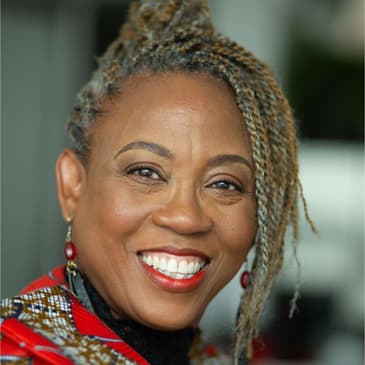
Unlock the secrets to spiritual liberation and transformative leadership with our special guest, Aina-Nia Ayo’dele. As a leadership coach, author, and ancient wisdom teacher, Aina brings a wealth of knowledge rooted in African spiritual practices and traditional wisdom. She shares her impactful journey with Sacred Leaders International and her instrumental role in crafting the confronting anti-Black racism strategy for the City of Toronto. Learn why Aina-Nia believes that true transformation is an ongoing learning journey and how this philosophy led her to establish Aina Nia Learning Journey Inc.
Discover the profound connection between activism and African indigenous spiritual practices. In this episode, Aina-Nia enlightens us about the significance of the ORI, the crown of the head, as a reservoir of wisdom, and how simple rituals like blessing the ORI can elevate our consciousness. She emphasizes the importance of honoring our ancestors through libation and the guiding role of spirits in our activism and daily lives. This conversation is a deep dive into how aligning our social, spiritual, and physical dimensions can foster meaningful change and a deeper connection to our heritage.
Moreover, Aina-Nia discusses her transformative 10-month program aimed at empowering Black women through a blend of African-centered and contemporary leadership practices. This initiative doesn't just build leaders but also creates a supportive community where women can navigate both professional and personal challenges effectively. Furthermore, Aina-Nia shares insights from her self-published book, "Self and Inner Journey to Remembering Her Power," and the role of social media in spreading her message. Tune in to be inspired by Aina-Nia's dedication to education, spiritual growth, and community empowerment.
Here is Aina-Nia Ayo’dele's connection information:
https://aina-nia.com/
[00:00:00] Ellington Brown: Welcome to SpeakUP! International with Rita Burke and Elton Brown!
[00:00:15] Rita Burke: As Elton so clearly stated, this program is called SpeakUP! International, and we crisscrossed the world to find the people that we consider to be community builders. Those are the people that we speak with. And so today, we're right back in Canada, as a matter of fact, in Toronto, and we're speaking with Aina Nia.
Who is a leadership coach, author, ancient wisdom teacher, and spiritual liberation activist. She's also our Yoruba priest and is initiated in various other ancient wisdom traditions. Aina Nia has presented it to academic, academic, cooperate, and fate audiences across North America, the Caribbean, and Africa.
Right now, there's so much more that I'd like to say about our guests today. But as we say on SpeakUP! International, it's best if our guests tell their own stORIes. And so I welcome you to SpeakUP! International, Aina Nia, welcome, welcome, welcome!
[00:01:38] Aina-Nia Ayo’dele: Thank you for having me!
[00:01:41] Ellington Brown: It is definitely a joy to have you sitting here having a conversation with us.
Rita has told me so much about you! So can you share more about your journey and what inspired you to establish Aina-Nia Learning Journey Incorporated?
[00:02:01] Aina-Nia Ayo’dele: So, uh, my journey has been interesting and long and diverse and interweaving one, like most of our journeys. It's not just this one. Straight line.
Uh, well, what, what, what I'll say is, you know, in the last, especially specifically in the last 20 years. Much of my work has been grounded in African spiritual practices and African traditional practices and other indigenous practices. And I've made it my business, not only to support myself in understanding this for my own journey, but also to teach.
I'm on this planet to teach. It's, I'm on this planet to teach and through my teaching, I heal and I bring reconciliation. And so I've, I was thinking about it the other day for most of my life, I've worked for myself for most of my life. I've had, I've been an entrepreneur and every now and again, I dip myself into the, uh, the workforce and work for somebody else, usually because I have a specific purpose.
And so, uh, for years we were operating as Sacred Leaders International, which was grounded in teaching and coaching. I'm a, I'm a also a coach. And, um, and after spending the four years in the city of Toronto in municipal government, uh, to do that specific work that I went there to do, which was to create the confronting anti Black Racism Strategy and, and create a unit.
To ensure that that strategy was implemented and then and then also extended that kind of service and support to the larger the larger organization and need, which was our community funding section of the city. And so I did a lot of work. It was a good timing, as a matter of fact, because by the time I expanded into the broader work, COVID happened.
And I think what I know to be true is that the ancestors must have sent me there at that time so that I would have had a targeted universalism lens so that our people, meaning our people of African descent and other Indigenous peoples, Who would be experienced would get the blunts of this, of this, of this, um, epidemic pandemic, um, would need targeted support.
And so I was responsible for a lot of that. When I came out of the city, I chose to, uh, to retire after four years. And get back into what I love, which is I love to coach. I love to teach. And I love to do that all the time. And so once I got back into that, I, one of the reflections I had was that the truth is, at least this is my truth today, is that for us to create transformation for us to have true transformation, it doesn't happen in a one shot.
It's actually requires a learning journey. Because we're all on the learning journey, whether we call it that or not, this, this life puts us on a learning journey. And so I decided that I would never again one shot workshops, I would be called to the workshop. I said I won't do that. I won't do that anymore.
I will take people on a learning journey, but I will not do that anymore. And so that name, so when I incorporated, I changed the name from sacred leaders international to an any, a learning journey, Inc. Simply meaning I, I, Aina-Nia, she who has purpose. My full name is Aina Nia Ayodele Ifayemi, but Aina Nia is there for taking this purposeful, taking you on a purposeful journey to transformation.
And that's where that name came from.
[00:06:04] Rita Burke: Transformation, a journey towards transformation that you certainly don't do anymore as a workshop, but you have to work alongside the people that you're working with. I, I fully understand that. Now in your bio, you describe yourself as a change maker. Please help our audience understand what that means for you being a change maker.
[00:06:33] Aina-Nia Ayo’dele: That's a really, really good question. Um, as I said earlier, my purpose, my purpose on this planet is to teach through my teaching. I heal and I create reconciliation. Those two things, healing and reconciliation, are purely about transformation. It's purely about change. And so when I look at my life, and I look at the different places and spaces that I've been able to touch, it has always been about going in and making change.
You know, I think about when I was, I was asked to come into the city as a consultant, and look at addressing anti black racism. And I remember the time frame that I was given it was kind of a little ridiculous only because I know nothing happens that quickly. But it was about 90 days and I and I said, I think I'm the wrong person.
Because anything I do must be meaningful, anything I do anything I touch anything I do. My father had said my father was an activist and he would always say, you know, wherever you go, make sure when you leave there it's better than you came to it. And so I walk on this planet in that way, I, it is my hope that after my conversation here today that I would have left it better than I came to see it.
So I'm constantly in my beingness, my intention is always, my prayer is always, let me move for change. Whatever I do, let it be for change and let that change be good change. And I do the same thing with my life. It is my hope every day that I am constantly changing. If somebody says to me, Oh, you have changed.
I'm glad. Because I don't want to be the same person I was six months ago, six years ago, 16 years ago. I don't want to be that person. I want just like nature, you know, the trees, I look at my trees every day and I said, these trees are constantly changing. So why would I want to be, stay the same?
And so that's where that, for me, that's, I am a changemaker. My very being on this planet is changemaking. Always, always, always. And my prayer is that it's for the better.
[00:08:56] Ellington Brown: As a changemaker, what memorable moments or key lessons have you learned from presenting academic, corporate, faith audiences across different regions?
[00:09:12] Aina-Nia Ayo’dele: You know, there's, there, there's so many. Um, some of them have been, I would say that simplicity, you know, um, we, We think sometimes as leaders and as teacher that we need to speak to people, especially in these settings and academics, civil society, so on. We need to speak in a way that is so exceptional and way up here and, and there is this need for to be higher than and impressive and so on.
So what I've learned is the simpler my conversation is the simpler, my messages, the more that my message is created in a, you know, as indigenous peoples, I love, and I, when I say indigenous, for me, I'm not just speaking of indigenous people of Canada, I mean, indigenous way of being, it's always circular.
And yes, there is usually a leader, but it's always circular because it's, that says that everybody is learning from each other. I'm learning from you. You're asking me these questions, but I'm learning from you. You're learning from me. It's this constant learning that is happening in the circle. So what I would, and any folks will tell you when I'm asked to speak, if at all possible, I'm always saying, create a circle.
Even if it's 300 people, create a circle. If it's a thousand people, create a seven, 10 people, create a circle. And they'll say, but we have tables. I said, make the tables in a circle, you know? So that, and if I can't avoid not being on a platform, I always try to do that so that I can be in conversation with people.
And so that is a key thing for me, a major learning point for me, as we teach, as we lead to understand that every single person who is in the sound of our voice is also teaching us. And so we speak from that place, you know, um, I'm really committed to you. Teaching and experiencing African centered knowledge systems.
Only because I do believe that must have been why the colonizers went straight for us. Because there is so much, there is so much gift, there is so much genius, there is so much in us. And our way of leading, our way of operating business, we're geniuses. And so all I am committed to is learn more about our genius so that I can share those genius methodology with folks.
And so I'll leave it at that because I, you know, you probably have more questions, but those for me are some of the key things that I've learned that, um, that supports me in my delivery, no matter who I'm delivering to it.
[00:12:16] Rita Burke: I fully understand and concur with what you're saying. I used to be. an educator and any classroom or setting that I walked into, I rearranged the furniture to create a circle because I intentionally didn't want that hierarchical structure that we've kind of grown accustomed to in Western societies.
Initially, people People squirm when they see that happening, but I did that intentionally because I knew what I wanted out of that. Because I think that smart leaders know that circles work better. Because indeed, like you said, we teach each other. We teach each other. Now you said that you're a leadership coach.
Talk to us about your coaching style or preference.
[00:13:20] Aina-Nia Ayo’dele: So, um, I, I coach the same way I teach from an African centered knowledge system. I coach from spirits, you know, and I coach leaders, mostly people in executive or some form of leadership position. And I also see human beings often as leaders in their own right.
But that's, if I were to say, who do I coach? I coach, I coach executives, I coach leaders. I coach senior management people. And no matter who you are, whether you are the CEO of a huge hospital or you're the ADM of a municipal government, or you are in charge of a University, it doesn't matter to me.
I coach everybody from spirit. So I start in that way, every coaching session, I do start with breath work and some people call it prayers, but certainly affirming and opening up our bodies and our minds and our spirits. I coach from a place of what people want, what their vision is. So, and I spend 20 percent of my time in coaching on the issue.
And 80 percent on the resolution. So, while I have therapeutic and counseling tools always in my pocket, I am not very interested, nor do I spend a whole lot of time talking about the things that have held us down for a long time, you know, a lot of time people want, but why did I do this? But why do I always, why do well, let's talk about what you're going to do today.
What's, what's the choice today, and it is not to minimize those experiences we acknowledge them they happened, but we have a choice today. And so I teach people how to make that choice today. And make that choice a practice creating a new pattern that will therefore disrupt the old pattern so that we can live a healthy and prosperous and fulfilling life based on our definition of that.
So it doesn't matter if this same, what I just shared with you is for no matter who I am coaching, because their, their, their, their desire, their vision might be about who their, their, you know, their staff or, or whatever, or mandate for the organization. Well, same, same principles apply, same principles apply.
So yes, the organization is 50 years old and it has been having these problems and okay. So what are we going to do today? What is, what are the, what are your choices? How will you make that change? What do you really want to see happen? And how do you do that in joy? So I teach people about living in joy, having boundaries.
Self love, self love, because if you are the Prime Minister of Canada and you don't love yourself, it's going to show up in the way you lead the people.
[00:16:45] Ellington Brown:
How does your role as an ancient wisdom teacher and spiritual liberation activist, You talked about several tools a few moments ago that you use when you are coaching. How does these two additional tools fit in your arsenal?
[00:17:07] Aina-Nia Ayo’dele: My arsenal of activism?
[00:17:10] Ellington Brown: Yes.
[00:17:12] Aina-Nia Ayo’dele: They absolutely fit because, you know, I have come to know that activism for us to make change in the world, we need to ensure that there is a balance and there is an alignment and our ancestors taught us that anyway, it's not my thing between our physical or spiritual or mental on our emotional,
the more aligned those things are, and the more grounded in spirit that it is. It's the quicker your activism intention will be, it will just ignite and fast track any, any vision you have anything you're, you know, currently, you know, by my focus right now is about peace and bringing peace to women.
That's activism. Everything that I'm much, much that I do is activism. You know, I, you know, we mentioned Jill earlier. Jill is always talking about the personal and the political. It's, it's one of the same. Right. And so that's how I see. I see it as well. But what I've learned over the years, because I used to do activism very differently.
You know, I thought that activism had to be in the streets. I had to be marching. I had to be being very loud. And I think those things also have its place. So it's not to say no, those things absolutely have its place. But where I've come to is that I've come to this understanding that when I pour libation, I do my traditional rituals and I do my African rituals and I listen to spirits and I say ancestors.
What is the direction today? Where am I? How may I represent us today? And I say, and I listen for ancestors directions, and I then act on the directions that I'm given. I have been able, I have evidence that by using the ancestors tool, I have been able to go into the colonizer's house and shift it. Of evidence and so it's absolutely aligned.
It's all one thing for me.
[00:19:40] Rita Burke: My next question was going to Sound much like the ancestors tools that you talked about, and I'm really curious to hear some examples of this African indigenous approach that you use. And I hear you say that it's important for the dimensions, the social, the spiritual, the physical, to be aligned. So talk to us a little bit more, please, for the benefit of our listeners about some of those Indigenous African centered tools.
[00:20:18] Ellington Brown: I'm excited!
[00:20:21] Aina-Nia Ayo’dele: A simple one that I think, you know, anybody, you don't have to, there's nothing special that you need to be or do. A simple one is understanding that our head, the crown of our head, Which in my tradition we call the ORI, or ORI is where our wisdom is held. This is our wisdom keeper. Yeah. .
It's our highest consciousness. It therefore means that it is important that we take care of our ORI and a simple way to take care of our ORI from that I offer. Is with water, you know, so I will tell you this I keep water on my altar always I go and I sit with my my ancestors at my altar and there's water there and I bless my ORI I bless my ORI.
I invite people to do that. No, this has nothing to do with religion. It doesn't matter what religion you are. It is a completely different thing. It's a way of being. And so, I bless my ORI and I, I, I bless all entities, all identities, all, all energies, masculine, feminine energies that I have here sitting in my ORI.
And I ask for its wisdom to come through me and come through my voice, come through my being, come through my arms. It's a simple practice. It's an ancestral practice. Our ancestors taught us that our ORI, our head, is so important. It is why Black folks, it's why people of African descent, gets, almost gets viscerally upset when people touch their head.
And many of us don't even understand why we do that. We think it's about our hair. No, it's not about our hair. It's about the fact that we know in our spirits that this is way too important for people to be touching it. And that we have to take care of it and that we, it's, it's a sanctuary almost, you know, it's a, it's an altar.
And so we have to take care of it. And so that's a practice for me that I use and I, and there are more elaborate ways of doing that, but very simply, very simply acknowledging those who have gone before us. Very simply just calling their names. It is said that, you know, we, uh, we, we, we are born, we are born and we die twice almost, you know, when we come in, when we go out, but also when our names are called.
And so this idea of calling are those who have gone before us calling their names, calling their energy into your space. And that knowledge in them and letting them know that while their physical body has left us, we know that their spirit is still there. Around us, and we invite them to do so. We invite that because they're in another realm and in this other realm in the spiritual realm where they have gone back to their original self.
They can support us and those are the tools that the colonizers took from us very quickly. It made sense, though, that they would do that because that's power. When we know how to acknowledge our ancestors have taught us a few things. Acknowledge and honour our spirits. The ancestors, elders and children.
Basic principle. steward nature be good and be kind to nature. Yeah, they tell us that community is where we is a place of belonging. So we must really steward it well, and and all of these different principles that have been taught to us that we can use at a practical level. And when we use them for ourselves, and we use them in community.
We will see the alignments and we will understand we will understand that we don't have to cry. Because one of our leader has gone we cry because we miss them for sure, but we can celebrate that we can understand that they came, they did their thing. And now they're gone to this other realm, and we could call their names and they will continue to take care of us.
So I don't know if that is your question. But, um, but those are some very basic things.
[00:24:45] Rita Burke: So before Elton comes with his most powerful question, you talked about libation. I understand what that means. I've been to a number of events when that practice was done, but very quickly, could you talk a little bit about the significance of libation for us as a people?
[00:25:07] Aina-Nia Ayo’dele: So, you know, it's a, it's a, it's a, it's a basic tradition and different parts of the, of Africa, different parts of the continent do it in different ways. Right. Some people use tobacco, some people use kola nuts, some people use water, some, you know, water and Gin is very, very common, but there are different tools that is used.
The key is that we do nothing. We start nothing without calling in the ancestors. So it's a call. It's a calling of the ancestors. It's a calling of the ancestors. But let's be clear, if we go into especially, um, so-called mainstream churches, Catholic, Anglican. It's the same thing that's happening. Same thing that's happening.
They didn't say it's ours, but it's the same thing that's happening. They're pouring water, they're lighting incense. They're, uh, on this land, indigenous land. They, they do it with tobacco, so they open up with tobacco, they open up with a pipe. Germany, it's the same thing. It's the same thing. All we're doing is saying.
We acknowledge you ancestors. We acknowledge your presence. And by the way, we're about to do something important. Please come sit with us. Come sit with us.
[00:26:19] Ellington Brown: Well, that's kind of interesting because when Rita brought up libation, I thought of just having drinks. But I can see that that word has multiple definitions.
So thank you for the education. I certainly do appreciate it. Can you talk a little bit about your sacred leaders training and how that transforms women leaders? In their communities.
[00:26:48] Aina-Nia Ayo’dele: Yes, so we've been doing this. Sacred leaders training was, um, was downloaded to me, uh, now, 14 years ago, almost 15 years now.
So, we've been doing this for 14 years. We're just at the end of the 14th year. And it was, uh, it was a call or a similar to women for peace was a call from the ancestors for me to bring women together and to teach them how to center themselves and remember their power and and you and therefore how to then remember their power.
And use that power to build their purpose for being on this planet and to build community. We take women, this, this was, this all came through, um, was divinely, um, directed. So we take women through a 10 month process. We really get into their lives. And we meet through these 10 months, we meet regularly once a month, we meet as a group.
And, um, and we do training. Most of the training is from an African centered knowledge system, but we include other indigenous practices as well. But we also include contemporary leadership practices. Um, and so, and to show women how we can use both to marry, you know, we marry both of them to strengthen them.
So, they might be. You know, they might be a professor at a university or they might be entrepreneurs, or they might be in senior leadership or middle management, or where they might be policymakers. They may be homemakers, right? Um, whoever they are is about then how do you, first of all, deep self exploration.
So let's stop mining everybody else's business and mine our own business. So deep self exploration to understand the self. Once their understanding of the self, then what are, then we give them multiple, multiple, multiple tools so that they can maintain that. So it's a, it's an integrated application process that we use our methodologies very much.
So the women don't have to come in and try to make up something. What are you working on? What is that? And by the way, why are you here at this time? We do, that happens very quickly. We have to get to that. Because everyone is here for a specific purpose. So why are you here? Okay, once we define that, then how are, how are you applying while you're here in the work that you're doing today?
Because you might not need to leave the job, but you might need to leave the job, right? You might not need to complete that business, but you might need, you might need to start a business. So we go through this 10 month process. Women become very, very close. And so we have now over these 14 years built a community is what we now have.
So they're, they're, they're partners, their children, their parents, everybody's involved. When we talk about sacred leaders, it's everybody. Now we gather together every now and again, and the community, but it's a very close knit community. We have defied the concept that black women don't get along. We have defied the concept that women of color don't get along.
We have totally debunked that. It is not true. What we do need is practices and tools that we use from an African Indigenous perspective so that we can deal with conflict. Because our ancestors say, conflict is not a bad thing, it's actually a natural thing. But it's how we deal with it. And so, and then we culminate on a land where, um, that is still practicing African traditions in whatever way they are.
So this year we're going to Belize.
[00:30:35] Rita Burke: How many women are you going with?
[00:30:38] Aina-Nia Ayo’dele: So this year we're going with, there will be six of us I mean seven eight of us.
It's usually the groups are very, very small and not everybody makes it all the way, but it's pretty intense.
[00:30:52] Rita Burke: We are having this very deep spiritual conversation with Aina Nia, who is an educator, a spiritual leader, an author, and Indigenous practitioner. And as you know, SpeakUP! International, we seek to inspire, to educate, and to inform.
And that is exactly what's happening with us today with our guest, and I thank you for that. Now, you have received a number of awards. Talk to us about some of those achievements, please.
[00:31:30] Aina-Nia Ayo’dele: I can't remember. So, honestly, sometimes I can't remember. Um, but you know, I think one of the, one of the awards that I, one of my first, the first award I received many, many, many, many years ago, I think it was in early 2000s, was, I'm going to talk about this word because I want to teach you.
Talk about something was most inspiring woman in Toronto, one of one of the one. I can't remember how many most inspiring women in Toronto. And when I, when I got that award, I didn't go to the, I didn't go to the ceremony. I didn't go to the celebration. I was still in a place in my life where one, I didn't, I was like, why are they giving me this award?
And first of all, there's so many other women that they can give this award to. Why they giving And I don't like awards. And I, I, I met and I, all of my activism self came out. This is, I, I have since come to recognize that when I receive an award, it is not just for me. It is for the people who came before me that didn't get recognized.
And so what I am, in fact, is I'm a proxy, right? I'm a proxy that is accepting this. So, I've been, yes, I've been recognized, I've been recognized by Jamaica, um, Jamaica 58th, I think, I was recognized as, um, one, most accomplished abroad, and at home, I, I, I really, that was an important award for me as a Jamaican, somebody who, um, is living outside of Jamaica.
And it's always making sure that my country is, is well represented, you know, I feel a responsibility as a Jamaican. So that was an important award. 100 Black women was a really important award as well because it was that I got it in the second year. You did too, Rita so we got the award together. Right?
And it was just the second year and they were kind of just trying to find, you know, where are, where are the women that are doing amazing things. And, and I remember, I, you know, much respect to, uh, Honorable Jean Augustine and Donna and, and, um, no, I can't remember the other woman's name. Please forgive me.
Yes, yes, that's, that's doing so has brought this into being. And then to have the book where we were celebrated, you know, as a black woman to be celebrated in this way I think is very significant and whenever I can, um, nominate a woman I do because there's so many of us doing very amazing work. And, and some of us are never going to be called.
So, we will be rep, we are the representation of these other women. Um, I got an award for lifetime achievement from, um, from black cab. I've gotten a word from the government when I left the city. Um, they really, uh, went above and beyond, I think. In recognizing the work that I've done there, um, in so, so many ways.
And so I'm very grateful that, um, I honestly, again, I can't remember that, but I'm very grateful. I am humbled, not in a humbling, bowing way, but humbled in a centering way that, um, that the work that I'm contributing to this world every now and again gets acknowledged. In this public way, you know, and so I, um, I'm very grateful.
My mother always wants me to send a picture or the newspaper,
you know, and sometimes I say to her and I was, you know, I was laughing Rita when you said you're you're a proud dropout because. I, I was, I had started to do my PhD and, and I, and I kept, I kept not doing it, you know, where you just keep not doing it. I'm like, Oh God, I, I didn't. And I kept putting off and putting off and one day I had a set, one of the process that we use in sacred leaders training is the cycle of completion.
And so every time my students do anything I do it as well and I was doing the cycle of completion. And I thought, how am I trying to do a PhD again? If, what, what, what? And then I realized I was doing it so my mother could say she had a doctor daughter!
And in that moment, I wrote a letter and withdrew myself. So I'm a proud dropout. Um, because, you know, for what, for what, for what? And so there are other ways to educate myself. There are other ways to learn. There are other ways to put information out there. And I'm, and I'm okay with not having a doctor behind, in front of my knee.
[00:36:40] Ellington Brown: You talk about purpose, and in one of the sentences that you said earlier, about women. I thought you were going to say women need to have a reason, but you did not. You said purpose, which really changed, at least for me, changed things around a little bit, because you're not looking for the reason Why?
Because we already know that. So it's about the purpose part about what they're going to do. So I just wanted to mention that I found that little gem to be, , inspiring. Can you talk a little bit about your work as a lead consultant with the Department of the City? And how to confront anti black racism?
[00:37:37] Aina-Nia Ayo’dele: Um, so, you know, when I was called, uh, called into the city to, uh, support this, it was right in the middle of black lives matter movement was at heights and, and the government needed to do something, right? The government needed to at least appear to be doing something. And, um, and so I was called in to do consultations.
The request was to do consultations with black community, see what black community wanted, uh, so that we could address anti black racism. I think that was the request. Um, well, it was, it was made clear to me, and I think I mentioned this before, that I was given 90 days and I said not, wrong person, not happening, right?
But it was made clear to me that, We had already had 41 years of reports, so, so if we had 41 years of reports, we didn't need to ask black people what they wanted. 'cause we had a black people had already told us over 41 years. Well we wanted in, in 41 by the way. It's, which was interesting in 41 reports.
So. What we did then was to look at those reports and analyze those reports and identify what black people have been saying, because it was the same thing. It was about health, it was about food security, it was about youth and children, it was about black leadership, it was about, it was the same thing.
And so what we, what the question then in these, in the consultation conversations, and by the way, I refuse to call it a conversation, I call it conversation, community conversations. Um, the questions then were about, if we were to do these things that we've been saying we want to do for 41 years, what would it look like?
If the, if the government was in fact to address it, what would it look like? And how would you know that it happened? And how, how would you want to hold the city accountable? Those, it was like three or four questions. And then we took the answers, the responses from those questions and developed. Uh, we talked to about over a thousand black, um, black community members at the time, and it was important for me to make sure when we talked about talking to black community members, it wasn't just the Caribbean people or just everybody, LGBTQ community, um, seniors, youth.
The so called continental Africans, Caribbean people, people who are, are, are originally from several, several generations. So, folks out of Halifax and so on, making sure that we heard everybody's voice. And then we pulled all of that information and created a report that became the five year action plan to confront anti Black racism.
It's important we're talking about this because Um, the council has approved for the 10 year action plan, which has always been the vision, right? To make sure that there was a large, a longer fold. What was important in this, though, was that it didn't become because it's not that this was the 1st time.
There's been difference. reiteration of this, but it was important to hold to hold the government responsible. You needed to make sure that we had resources attached to the plan and that part of the resources was staff. To make sure that there were black staff dedicated in the city that was in the base budget of the city.
Not any other budget, a base budget, right? So that it was less likely to be kicked out. You know what I mean? So, those things were really, really important to weave into this plan. And so once the plan was passed, um, then the city called and said, Annie, I know you're gone because I'd already done my job, but we need somebody to lead this.
It was a big decision for me to make because I was already have in that was what I was doing. It was my business. And so, again, the ancestors had sent me to the city to do the consultation. That's another story of how that happened. Um, and so I went back to ask the ancestors, you know, and they're like, well, you got to do it.
And so I put my business on pause and went into the city as a staff established a unit became became the manager for the unit and hired staff, and that's how we started with. There were only five of us. And by the end of year two, I requested. That we increase the, the, um, the staff capacity because there's no way we would be able to do what we had already completed 50 percent of the action plan at the end of that time anyway, but for us to do to really create true transformation.
We needed more stuff. So at this point, I believe they're operating with about 10. Staff, um, staff compliment and lots is happening. And every time I hear something, I'm like, oh, my goodness, we really did that. This is why that is happening, you know, to be able to see. I was there a couple of days ago, uh, the city invited me to do something and I couldn't believe that this, these thoughts that we had this vision.
That we then implemented is so far reaching today.
[00:43:01] Rita Burke: So you've done amazing groundwork, very, I will say, African inspired groundwork. And you've created a path that so many others could follow. And I celebrate and applaud that for you and for our community. When I introduced you, I said that you were an author.
So I need to know more about what you have authored. Talk to us about your book or books, please.
[00:43:38] Aina-Nia Ayo’dele: Well, I've been, I've been writing and publishing for a number of years because the leadership process that I have, it's a full curriculum. I've had workbooks and so on. Um, so I've been, you know, I've been doing that for a while, but, uh, I'm trying to find my book, in 2021.
Um, I knew I was sitting on four, four inspirational books. And, and Spirit was really nudging me and waking me up in the middle of the night to get this published. So I finally published the first one, which is called Self And In A Journey To Remembering Her Power. And this is a 31 day process that really just supports people, anybody.
And I understand young people are reading it. There's their book, there's their schools that are buying it for their young people. And it takes you through 31 days of affirmations and some reflection and then a portion of it where you can then there's an affirming question that I asked at the end for people to pretty much journal on and they can use this book as many times as they want in any way that they want couples use it.
I get most couples use it. Families using groups are using it. As I said. Schools have bought the books and are using it. It's supporting folks in however, so this is the first actually of four. Uh, you know, I know you know this. I had chosen to self publish, and it takes a lot of energy. And so I have the other three but I also have some other books that are that are coming through me, so I don't know, we'll see, but um yeah but I've been publishing for a while.
[00:45:31] Ellington Brown: I noticed, you have a lot of, , videos on YouTube on different, topics. How are people responding to that form of communication?
[00:45:45] Aina-Nia Ayo’dele: Uh, social media clearly is, you know, I think the way to communicate these days, um, much of my, my videos that, that my team creates, it's not me. I wouldn't even begin to know how to do any of that.
Um, but the team creates these videos. Um, I think that's the way the message is getting out. You know, I, I resisted. I was on. So I was on Facebook. I built sacred leaders training on Facebook. Right? So, I understand the power of social media, but it's gone to another level now. I think we're, um, especially.
Less people are reading. If it's not on a video, the message is not there because nobody and the video has to be short. It's a very interesting time that we're in or nobody listens. Right. Um, but many years ago, I remember hearing Wayne Dyer said that he went on PBS and I actually have something on PBS right now, but he went on PBS.
So that he would reach more people and so I, I, I, I keep that in the back of my mind. I think what you're all doing having this podcast. Um, SpeakUP! International is the way to get reach more people, right? There, there are only so many people that I can talk to, or I can go to an event or I can be, you know, I was in the U.K. The other day.
There's only one of me and I refuse to be burnt out and I refuse to overwork myself. So the best way then is through these videos, I think, right? And through these other platforms so that we can reach people. The response has been good. Um, we're currently in a, on a campaign for women for peace. That's a movement and it's interesting.
I'm getting these notes from folks. That are finding it really powerful and informative and inspiring for them and for their work and for them personally, and so on. Last month, we focused on violence against women and girls. And so I got a lot of responses about that, mostly from women and girls or women who know women and girls who have been violated.
And so I might repeat that theme again in a few months, but what we're going to do with this Women for Peace anyway, we will culminate on International Women's Day next year, so it will be a full one year run, and we'll culminate in a summit again online, on video, so that more and more people can benefit.
[00:48:34] Rita Burke: So you're out there, dare I say out there, or in here, doing some powerful, absolutely amazing, amazing work. Let's suppose, Aina Nia, that you were invited to speak to a graduating class. What three nuggets would you like to leave with those graduates?
[00:49:07] Aina-Nia Ayo’dele: I love that question, Rita. The first one, you know, I would always have to go back to our ancestral teaching. And the first one I would leave with those graduates is to Know yourself, know yourself, define yourself for yourself, know yourself, know your purpose, know why you are here on this planet, know yourself.
Once you make yourself your business and you get to know yourself, identify your own joy and share that with the world. It's let everybody experience you when they come into contact with you. I will say the same thing that my father said to me, leave, make sure anywhere you put your mark. No matter what it is, no matter how small, if you get, if you get a job that you think is not up to your accreditations and you decide that you're going to take it because you need this, you need this, this income yesterday, take it.
And change it, take that role and make it something that nobody could have imagined it, no matter how small, blow it out of the water, put all of you in it and create almost like you're creating a new job description that is going to just blow the thing out of the water, know that you can do that. Do not see anything that you do as too small because everything is significant and every move that you make in this world is significant.
And the last thing I would want to say to them is to ensure their life is in balance. Ensure that they are always managing and aligning their mind, body and spirit, not one over the other, not one less than the other. But that they're always do the things, engage in the things that will create alignments of their mind, body, and spirit, because once those things are aligned, and it's not just about food, eat the right food, it's not just about running, do their, it's, it's all of it.
Once they are aligned, life will be simpler, life will be easier, and they'll realize that it doesn't have to be hard. Even though we're black people, we're people of color, even though we're indigenous people. And the story says, well, if you're not white or you're not young or you're not, you can't do that.
Disrupt all of that. Disrupt all of that. Once you're aligned, you can and will experience anything you desire, because you deserve it. What do you desire,
[00:52:24] Ellington Brown: One thing that I'm going to take away from this conversation, in fact, there's actually two things. First one is, know yourself, and you talked also. Secondly, You talk about spirit and how that spirit moves you to say and do certain things, and that is a powerful force a lot of individuals are not aware of.
They may call it something else. Oh, you know, this thought in the back of my mind told me not to do that. And so I didn't do that. And Lord have mercy. I am so glad that I did not go down that path. Was that something in your mind or was that spirit telling you, don't you do that? So it really opened up a, another path of conversation that we could talk about for at least an hour.
And I really do love the way that you tap on that, reason versus purpose was another thing I thought was quite interesting, sacred leaders training, which you provide so that you're able to transform women leaders and, , their communities. The North America's first government sanctioned strategy and office, so that when you were able to address black racism and the challenges that you faced, I really enjoyed this conversation!
I found it Thought provoking! I really am hoping that when you write that next book, number two, that you will come back to us and allow us to have yet another conversation with you, because it was quite stimulating. Rita, do you have anything that you want to add to that?
[00:54:33] Rita Burke: I just need to say thank you a million times for pouring such richness into me.
I often say that at the end of these sessions, these conversations, I am buoyed. I get energy, I get spirit, I get joy. And today's no exception. I thank you, thank you, thank you, thank you so much.
[00:55:04] Aina-Nia Ayo’dele: Thank you so much for having me. This is a beautiful conversation. I was also enriched. Um, you know, your questions were, you know, when questions speed you, uh, I experienced this conversation where the questions fed me.
So. I truly appreciate it. Thank you so much. I want to spread the word. So I want to tell my team about speak out (SpeakUP!) International.
[00:55:30] Ellington Brown: Please do!
[00:55:32] Aina-Nia Ayo’dele: So whatever I need to so they can put that out there somewhere on all these medias that they put things on.
[00:55:41] Ellington Brown: Once the podcast is ready, you're going to receive a link from us.
[00:55:46] Aina-Nia Ayo’dele: Okay.
[00:55:47] Ellington Brown: And you can do whatever you want with the link. We're not going to tell you, oh, you can't put it on X, Y, Z. We're not doing that! You can tell your marketing people that they can run wild with it. We're not going to get in the way of spirit.
[00:56:04] Aina-Nia Ayo’dele: I love it. I love it. I love it because yeah, I love what you're doing, and I didn't hear about your podcast before now so I'm really happy that it's in our, it's in our purview now.
[00:56:16] Ellington Brown: Thank you for listening to speak up. Exclamation point international. If you wish to contact and a Nia, please be prepared to submit your name, your email address, and the reason why you wish to contact and a Nia. At info@aina-nia.com. And the Nia has other social media platforms you can use to connect to her listed in the description section on Spotify and other platforms.
Are you interested in the opportunity to be interviewed and have your cause promoted by SpeakUP! International? We invite you to connect to us by sending a message that includes your name, company, or organization name, the valuable service you offer to your community, and your email address to info@speakuppodcast.ca.
Worried about your confidence as a interviewee? Don't fret! SpeakUP! International can provide you with the necessary training. So you shine during an interview. To receive training information and a 10% discount about the SpeakUP! International's podcast interviewee trainee program, email us at info@speakuppodcast.ca.
You can also reach us using Facebook, Instagram, Twitter, and LinkedIn.
To connect to our podcast, use Spotify or your favorite podcast platform and search for SpeakUP! International. You can also find our podcast using our web address, www.speakuppodcast.ca. Our logo has the woman with her finger pointing up mouth open. Speaking up.
By joining Patrion we can offer you new and exclusive opportunity to become an integral part. , of the continued success of our podcast. Your financial support will enable us to cover the cost associated with producing high quality content, , such as equipment upgrades, hosting fees and professional editing services. As a member of our Patrion group, you will gain access to a range of exciting benefits! We are working on providing you early access to new episodes, the opportunity to suggest topics or guests for future episodes. Your contribution will not only help sustain the continuity of the podcast but will allow us to enhance the overall listening experience for all of our dedicated followers.
Help us help you! www.patrion.com/speakupinternational.
SpeakUP! International, we aim to inspire, to inform and to educate!