
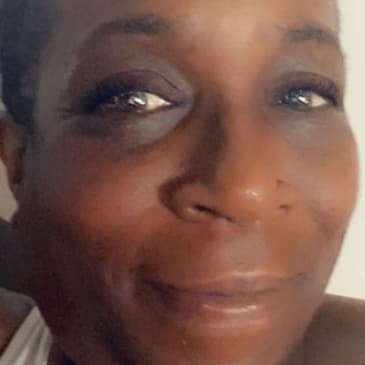
Ms. Denise Burnett's journey began as a former radio broadcaster, where she ingeniously utilized the power of Caribbean music as a platform for social commentary. Through her insightful broadcasts, she fearlessly addressed the challenges and struggles of Afro-Caribbean people in Canada's face.
Denise has been a community worker by trade for over three decades. Her extensive experience spans various roles, from frontline work to case management. Today, she proudly serves as a program manager at one of Toronto's pioneering modular homes for the chronically homeless. Through her leadership, she continues to be a beacon of hope for those who have been marginalized and overlooked. Denise is a strong voice, fighting for the rights and well-being of those who most need it.
To our listeners, I am pleased to introduce you to Ms. Denise Burnett. Her wisdom, experience, and unwavering dedication will undoubtedly inspire and enlighten us all. Join me as we delve into the incredible journey of this remarkable woman and learn from her invaluable insights. Without further ado, let's welcome Denise to the podcast!
Welcome to SpeakUP! International with Rita Burke and Elton Brown!
Rita Burke:To today we have a special guest with us. All of our guests are special, but this one is a woman that I've known for a lifetime, so to speak. We are more than friends. We're more than community members. We are like family Denise Burnett, welcome to SpeakUP! International.
Denise Burnett:You are so welcome. Thank you for having me you're absolutely right. We're more than friends, we're more than community members. We are family.
Rita Burke:So let me tell her audience a little bit about Ms. Burnett. Denise Burnett is a mother, she's a grandmother, she's a sister, and she says she's a human being and friend. Now she's a former radio broadcaster that used the social commentary of Caribbean music to address the issues faced by Afro-Caribbean people living in Canada, and she did a marvelous job with that. I don't know she got paid for it, but I hope she did. Denise is a community worker by trade. She has more than 30 years of experience working with racialized and marginalized communities in Ontario. From Frontline to case manager, she is now a program manager at one of Toronto's first modular homes for the chronically homeless. Denise continues to advocate for the marginalized, racialized, and homeless members of today's New World. To our listeners. Meet my good friend, Ms. Denise Burnett!
Denise Burnett:Aw, thank you so much. Thank you for having me!
Elton Brown:I enjoyed our pre podcast conversation with you, Denise. You have a excellent sense of humor and I know that this podcast is going to be very light and full of humor. Yes. So you work with modular homes for the chronically homeless in Toronto. What actually do you do?
Denise Burnett:That's a good question because right now I think I do a little bit of everything. I'm frontline, I'm case manager, I'm deescalating, I'm supervisor, and then I govern the entire building. So it's a three story 56 unit apartment building in on, in Toronto that has now become home to the chronically homeless. So it's either six month of homeless the year we're in, or 180 days and beyond the previous year. So long as you are, quote unquote homeless, you could be eligible to get one of these units, and so they're. Basically pre-made apartment units that are dropped into the frame of the building. And so they're very small. They're like a bachelor apartment. They come with a bathroom, a fridge, a stove, a microwave, a little kitchenette area. And then you have your little room with a couple of cupboards and shelves that are there. And so what I do is I manage a team of maybe 42 supportive housing workers. Along with ADL that teach life skills to some of these tenants that are now housed on how to keep their apartments clean. They, we, they, we take a lot of things for granted when it comes to someone that's homeless versus someone that's never lost their home. And an example of that is, you and I have been housed, or we live in our homes or apartments, and we know that we have to change the light bulbs. We know that we have to empty the garbage. We know that we have to flush the toilet. When it comes to somebody that has been chronically homeless they don't know anything about changing a light bulb. They don't know necessarily where to throw their garbage, right? And so we teach them how to do these things so that they can maintain. Their units, their apartments. So I do all of the administrative duties of a building as well as managing the team, as well as offering clinical support and working with case managers to ensure that the tenants actually keep their units and that they're not evicted for things like, keeping their apartment in disarray or for hoarding, and so the population is one that's a combination of substance users, mental health users acquired brain injury, cognitive disorder. So it's a combination of everybody living under one roof. Needless to say, it can be quite tumultuous at times. At times it could be very tumultuous at times, but I love the work that I do. I value the fact that I have contributed to someone keeping a roof over their head.
Rita Burke:Ms. Denise, my next question was going to be, what is in that for you, apart from a pay cheque? What kinds of satisfaction? Does Denise get from working with people who are homeless?
Denise Burnett:Besides the fact that it's a job and it, it fills in for all the little monetary components of our world that we live in. I think it's satisfying cuz I was raised by a woman that, that taught me that you're always supposed to help. Doesn't matter what people look like. To me that's the satisfaction. But I can save one. We do it one at a time. I don't go to work thinking, oh, I'm gonna save all 56 of my tenants. I do it with one at a time. It's inbred into me is that if you see someone in need and you are able to help, because the satisfaction you get from that, the money isn't worth it. The money isn't worth it. And my mother was a God-fearing woman and she believed that we are here to take care of each other and to look out for each other, and that the reward is not earthly. It's somewhere else. So for me, that's very satisfying, knowing that wherever it is, once I've passed through this earth, that'll be recognized. That I helped people, that my brothers and sisters help people, and hopefully my children will help people too. And to me that is great because I know what it's like not to have, not to. Have all of your needs met and there were people in my life that helped me to get to where I'm at today. So I'm just playing it forward and to me that's the reward.
Elton Brown:How do you find marginalized, radicalized individuals? How do they find you for help?
Denise Burnett:It depends on what organization I'm working with at the time. It's really, dropping the hat, you pull a straw and if I'm there, I'm gonna help. I'm also that person that would never see someone on the streets and not help them if they needed some sort of assistance, right? If someone fell, I would go and try and help them to get up find out if they needed me to call an ambulance. If someone's short 50 cents at the store and I'm standing behind them, I have no problem giving that 50 cents. And so I don't think people necessarily come looking for me. I just think that if I'm in a place where someone needs help and I'm there, I'm going to help
Rita Burke:Denise at SpeakUP! International we seek to inform, educate, and inspire and we're just the beginning of this interview, and I believe you were helping us to meet those goals. Yeah. With our listeners right now. Right now. So let's switch a little bit. And talk about your tenure at the radio station. What took you there in the first place?
Denise Burnett:Rita, I don't know if in over the years I haven't shared this with you, but it was fluke. I have to tell you, it was complete fluke how I ended up on radio. I was a student at George Brown College doing my community worker diploma and in the second year I needed to do placement. Somebody said, go to C I U T. They do volunteer and it's community radio. It's right up your alley. You should go and apply. And I did. I went and I applied, and Shauna Farks was the program director I think at the time and so I met with her and she told me to come back the following week on Thursday at nine o'clock, and I did, and at nine o'clock she put me on the air and said, you're live. And I was like, ah. Didn't know what to say, didn't know what to do. I flustered, but I loved it. And it lasted for 20 years that I was at C I U t doing that program. I did caffeine free on Thursday mornings from nine to 10 30, and then I got involved with Black Roots Radio, which was a program that I created and hosted on Tuesday mornings. I was a bit of a bleep' disturber. I don't. I think I like to be provocative. I like to stir the pot a lot. It ended up costing me the show, but I would do it again. If I would have the same result, I would do it again and I learned a lot about myself during those 20 years cuz it definitely. Wasn't where I was headed, but it worked well with the work that I was doing, the music that I loved, and the community that I belonged to.
Elton Brown:You talk about returning to radio broadcasting, being a podcaster, and how do you see. Being able to address issues faced by the Afro-Caribbean people in Canada.
Denise Burnett:I think our issues are still there. They're there. They haven't really changed. And the show that I would do would be a reflection of what was and what is. Let's look at where we are now. It would be 20 years later, 30 years later, what has changed within the community? What are we doing within the community? We've experienced so much, for 20 years in this country, there was one black man a year being gunned down by our police department. We've survived COVID. We were the primary care workers in hospitals, old age homes, shelters, modular homes. We were the ones that were up in the front line doing a lot of the work for a lot of very sick individuals, which my community, our community has always been service providers, right? And so I would wanna look at what we've learned. In the past 10 years, I wouldn't even necessarily need to go back 20 or 30 years. But look at what we've learned and survived through this pandemic and what is our future gonna look like for our children because there is still a lot of isolation going on. There's still a lot of loneliness going on. Mental illness has quadrupled not only in Canada, but around the world. People are still reeling from loss, and so I think a place where people can come and share their experiences. The lessons that they learned a message to the next generation is what a podcast coming for me might look like.
Rita Burke:It sounds truly exciting, Denise. So go for the podcast!
Denise Burnett:I know I have to do what Steve Harvey says and jump. I'm finding a lot of reasons as to why I'm not doing it yet, but maybe after this and my conversation and participant on this particular podcast, it'll be my motivation and my inspiration to just do it.
Rita Burke:You mentioned Denise, that you learned a lot about Denise when you were on C I U T. What else did you learn?
Denise Burnett:Think over. Over the years I've grown into my skin. I'm finally comfortable with who I am, and I'm not too concerned about what people think of me anymore. Whereas I think during a lot of the times at C I U T I was concerned about what people thought of me. I don't care anymore about what people think about me. I'm comfortable in my skin. I know my own intellect. I'm loving, I'm caring. I think I'm a wonderful mother and the absolutely coolest grandmother ever out there. I'm proud of the fact that I have a 41 year old son that has never been apprehended, arrested, charged. By the police never got involved in any negative behaviors. My daughter is a shoe designer. She's doing incredibly well. I've always believed that we have to allow our children to be who they are and not who we necessarily want them to be. And I think I've done that.
Rita Burke:I know for a fact. Let me interrupt you a little bit. I know for a fact that your parenting was by intention. Yes. It definitely, everything was... Everything. You did for and with your children was synchronized and organized. Yes. And I like that. I admire that.
Denise Burnett:Thank you so much. It's paid off. And so what I've learned about myself is to, I'm determined. I'm determined I'm strong, but, and it's why I say this, I'm human. I cry. I have moments of sadness. You can't take that away from someone. And I think a lot of us as black women go around with this shield that we think we're protecting ourselves from all of what's out there, and we're not, we're actually letting a lot of that stuff in because it's the type of shield. That you're wearing. And God, once again, my mom and God and that armor that I needed to wear every day and her prayers for me, for my children for the entire family has bought me to where I'm at right now, along with members of the community that supported me, that encouraged me. Rita, you and Sam were stalwarts in my life. When I had to get to the radio station at six o'clock in the morning and there was no bus, there was Rita and Sam that helped me to get there. So remembering where I came from was also an important factor and remembering the people that nudged and encouraged and said, do this. You can do this. You're good at it. Don't stop. And that to me is rewarding. And has helped me to grow into the human being slash friend that I am to, to many people today.
Rita Burke:From my perspective., everything you've done with excellence or striving for excellence. And admirable. Yeah. Thank you. Thank you.
Elton Brown:Denise, you have been working with individuals who are homeless and coming up with this beautiful idea of creating modular homes for them. All of them had various backgrounds and they're all housed together. How did you help these individuals find permanent housing? Were there so workshops available or government assistance?
Denise Burnett:So let me give you a little rundown. So John Tory, the mayor of Toronto during the pandemic decided that they had to address the homelessness and so the modular homes were bought in. The idea was bought in. My location is one of the first modular homes in the city of Toronto. And it was literally, I believe, through the pandemic that this, these buildings were put up. So my building is only two years old, two and a half years old. I'm the second program manager there. So there is a process, people there's a hub of information and resources and referrals that come through. The city of Toronto and B, that access 0.3, 1, 1, 2, 1, 1. If you're homeless, you would nor and you're living in a shelter, you would work with a case manager. Referrals are done, assessments are completed. Input is given as per whether or not this candidate for a unit in the building is going to be a good fit. If he or she is. Then they're bought in. They're moved in. We provide the tenants the organization that I work for, which is Coda provides the tenants with the supports they need to live independently on the building. So Modular Homes is not my brilliant idea. It's provincial slash municipal funded initiative that the mayor of Toronto initiated during the pandemic. I am just an employee there. And so I have gotten to know my tenants that live on the building. I've gotten to know my staff. They do come from a variety of various backgrounds and they're popping up more and more. They're becoming a solution to affordable housing in Toronto they are rent geared to income. You can be working and living there. If you're making low income you can be on assistance, you may need, some disability supports. All of these things are umbrellaed under one roof, and that was the birth of modular homes. So I know that more and more they're popping up across the city as a means of affordable housing. Right now they're at single individual unit, but I do believe they are looking at family units being built also in order to support the housing crisis. Not only the homelessness, but the housing crisis. Right? And I reflect back in, in my years and when I first started working in this department, in this area of work we thought we were gonna eradicate homelessness. 25, 30 years ago when people decided that they were gonna work in the shelters or that homelessness was being addressed, we thought we were gonna eradicated. It's 30 years later and it has just exploded. With the pandemic, it's double, it's imploded within the explosion. As people lost their jobs, as people were unable to work the issue has become that much more urgent. We don't live in the Caribbean. We live in a country that nine months out of the year. It is cold! So to be living on the streets in the city or in any country like Canada or the United States, or England, for instance, is a shame. We, that this should not be happening. This absolutely should not be happening. And our government needs to step up its game and we, the people need to step up our game. I see. You move out of an apartment that you paid$1,500 for and he's gonna re-rent it. He's tacking$900 on that to rent it to the next person. How are we supposed to survive? Are we not our brothers and sisters keeper? Where did that philosophy just go? It's like during the pandemic, we were so thoughtful. We were going out and playing music on the streets to entertain the seniors. We were looking out for each other and going to nursing homes to check on our seniors and our elders. And once the shield was lifted, we have just become ugly to each other.
Rita Burke:Right back on.
Denise Burnett:Worse. We're not even, we're not sitting back to where we were. We are worse. We've lost the empathy. There is very little compassion. We judge that person sitting on the street corner asking you for a dollar. The difference between myself and that person asking for a dollar is that I know where my next dollar is coming from because I have a job. He doesn't and in me giving him a dollar, is that gonna break my bank even if I'm working at low income? And when we look at the substance users, we judge them, but do we understand the path that they walk through as to why they need to hide their pain?
Rita Burke:I can feel the passion. I can feel the passion for people who need your support, who need you to advocate on their behalf. Let's shift a little bit. You, to my mind, have been one of the community activists. I don't know if you like to be labeled a community activist, but I think you have done in many ways. Who else would you put in that category? Name me a couple of people.
Denise Burnett:In regards to activism on a whole I'm going back, I'm thinking Ross, Rico, wa was a huge activist former radio broadcaster. There were even, yourself, Rita, you and Sam. I Sadu Tipper from Tipper Fast Foods, all of the radio, the record stores that we had upon Eglinton in there even on St. Clair and Vaughn some of the restaurant holders, Racks they were all advocating in their own little way. Clifton Joseph, Jones and Jones. There, there is a sleuth of us that were out there doing the work and that we're still doing the work, just not as we used to. We've come a long way in, advocacy for the underprivileged, for those that were gunned down by Metro's finest for our men and women that. Had to work twice as hard as police officers in order to be able to even get any sort of work done. We've got lawyers now in our communities that are good, that are strong at what they're doing, that understand the legal system we have. Children that have never been incarcerated and have no intentions of being incarcerated. And so I think it's, that whole, it's all of us. We've all been advocates in one way or another. Maybe not out there on the front page, but some of us have had to work behind the scenes in order for those of us that have been on that public stage to be able to do the work that we do. That's a tough question in regards to, who else, because there, there were just so many that were out there with me that, Dudley Laws, Charles Roach, Lennox Farrell, they were all advocates, demonstrating and protesting against some of the most horrific experiences of our mothers of our fathers, that lost family to racism. And to hate. So there that, there's too many to say.
Elton Brown:I would definitely a agree with you on that. We've had so many things that pushed us into the darkness, I'm gonna call it. Yeah. But throughout all of this, COVID homelessness, you helping individuals find homes. Give us a feel good story through the darkness comes to light, give us a feel good story.
Denise Burnett:Oh, there's a lot of feel good stories out there, but one that comes to mind is a young man that many years ago, I. Helped to get into his own apartment. And it's a yo-yo, right? You go back and forth, you get the apartment, you lose the apartment, you get the apartment, you lose the apartment. And one day I was not at this job a job that I had a couple years back and he showed up there and I thought, oh no, you're back again. You're on the streets again. What's going on with you? And he goes no. Back on the streets. I just came to give you this and he handed me a card and I said, okay what's going on? He says, open it. I opened the card and he was about to get married and I was his best woman. I represented him. It was just me his parents his bride. And I stood beside him as his best woman. When he got married. He has since had a little girl and he, she calls me grandma. And I'm very connected with them in that regards. Like I said, initially one, I start with one. If I can help one then I've done something good. And so this young man is doing well. He's married, they're renting an apartment, they have a little girl and he forever sings my praise and. That's my feel good story. That's what keeps me going every single day.
Rita Burke:Denise, that was a tear jerker. Yeah. That was a tear jerker. So when you give with your heart and you give with your soul.
Denise Burnett:If you don't give with your soul, you're not really giving. You've gotta give. If you don't give worth your soul, you're not giving. And you really can't judge because there, there are more feel good stories out there as amidst the bad ones that are out there. There are some positive things going on for some people out there. Even in myself included, I've had my challenges in, maintaining work and getting work especially over the past couple of years, but, God has blessed me with the role that I'm currently in right now, and it's a perfect fit for me. It's a perfect fit for my team that I work with. We operate from a team perspective as a manager, I gotta be able to do some of the grunt work too. Because I can't manage a program and think I'm up here and my team's down here. No, we're all up here together, right? This is where we all are and we have to bring everybody else up here with us. And so that's the model that I adopt. I'm grassroots I'm solid in, what I speak. I'm fair, but I'm firm.
Rita Burke:So you walked to talk, you walked to talk. In other words, you walked to talk. Yes. Wonderful. Wonderful leadership. Wonderful leadership. Now Denise, what would you say was the best piece of advice that you were ever given?
Denise Burnett:Rita, I don't know if you know this, but I used to date Hurricane Carter and he taught me, That prayer is acting like you have what you yet have not, and you will have it. And initially I didn't understand that. What do you mean? Prayer is acting like you have what you yet have not, and you will have it this from a man that was incarcerated for 20 years for a crime he didn't commit. Then I started to get it. I, if you want a house, act like you're gonna get a house. If you want that shoe in the window, act like you're going to buy that shoe in the window and you will have it and it works. You act like you have what you yet have not, and you will have it and that might dear is Faith. You're praying in faith. Knowing that you are going to get this, not doubting it, but knowing it. That has been my life lesson from him. That is, think you're gonna lose your job, right? You gotta start looking for a job and acting like you're moving on to a better job, not gonna be stuck in this job. And that the challenge of the job that you're experiencing is the here and now. But it's not gonna be like that tomorrow, right? And so I think keeping the faith, knowing my God and being eternally grateful to the woman I called my mother, who prayed for me day and night, who wanted nothing but good for me day and night. Recognizing that when I had my own children was huge. And when Ruben taught me that and I was able to process it and put it into action the world became my foot story in regards to what I want. I wanted to renovate my kitchen 20 years ago. I wanted to renovate my kitchen. I was gonna renovate my kitchen. I didn't care. I was gonna get done. 20 years later, I renovated my kitchen, right? I kept my myself focused on what I wanted. I knew it was gonna happen at some point or another. And I believed it. More importantly, I absolutely believed it and I renovated my kitchen. I believed that my children were not going to gimme no hard time. We weren't gonna be stressed. I purposely raised them this way. I made sure everything lined up. I believed what I was thinking inside. And I'm blessed with two wonderful children. And I think if.
Elton Brown:So when you are not shouldering the responsibilities of motherhood, the issues that are faced by the Afro-Caribbean people in Canada, what do you do to relax, to have fun
Denise Burnett:I see my grandbabies! I'm always the mother. If I'm not a mother to my children, then I'm a mother to somebody else's. I absolutely enjoy my grandchildren every time my granddaughter starts high school in September. My grandson and I were born on the same day, and he enjoys playing nights and kings and queens, and although I'm usually the evil queen, every once in a while, I'm the good queen and I get to knight him. I am really into the Afro Africa culture. I've been reading a lot about the Nigerian movies on YouTube. They're my leisure time. I love to cook. I love to listen to music and more importantly now I love my bed. I like to sleep. So I do a lot of that and you never stop being a mother. You, you never stop being that community person. Once you're a community person cuz it's in you. I just love living life at this point. I like to garden. I hate worms. My kids laugh at me cuz I'm out there gardening. And then you Yeah, and I'm done. I can totally spent cuz I've just seen a worm.
Rita Burke:I'm hearing the drums of Africa still beating in your veins.
Denise Burnett:Oh yes, definitely.
Rita Burke:And I'm also hearing, I'm also hearing that you set aside time for your own joy. Yes. Consciously. Intentionally, yes. I like that. I like that.
Denise Burnett:On a Saturday morning, I used to have to get up and get everybody breakfast and make sure the house was clean. Go grocery shopping, laundry's done. I don't do that anymore. I lay in my bed and I get outta bed when I want to. And I take my time and cut through my home and I, I enjoy my home. I love spending time with just me. I love lavender, so I love hot baths. I, use eucalyptus in the tub. I do a little bit of everything and I, I love to read. I read a lot of books. Sometimes they're Afrocentric, sometimes they're clear fantasy and they're nonsensical. But I get to escape in my own. Little mind. And I do enjoy my work. So it's always a part of what I do. I do enjoy being a mother, so it's always a part of what I do. And that's me in a nutshell
Rita Burke:Way to go. So then, Denise, what's the book going to be called? When you write about your life and about your story and about your aspirations and about your dreams, what is the book going to be called? That I, I pondered that and I really couldn't come up with a title, but I do the title My Sister's Place because I believe that I'm your sister and you're always gonna be welcome at my place. And The book would have to insinuate that, that it would be either Welcome to Your Sister's Place or it would be Sister's Place. Because I am that warm, fuzzy, welcoming, down to earth, knock you on your behind when you're doing foolishness, a sister, right? So yes, it would. Sister's place comes to mind.
Elton Brown:So my sister, it has been such a pleasure having this conversation with you, especially on a day like this. The sun isn't really shining. But the good part is you are shining. You have been our sunlight this morning and I'm sure our listeners will fill those rays of sunshine that will inspire them and carry them on through today. I wanna thank you and please come back to SpeakUP! International where you are always welcome.
Denise Burnett:Oh, you're too kind. I would like to take this opportunity to thank you both. It's been a pleasure. I've definitely enjoyed my Wednesday morning with both of you. Keep up the work and I will gladly come back because I'll be letting you know when I'm starting my own podcast.
Rita Burke:Elton is a pro and he'll help you.
Denise Burnett:Okay.
Rita Burke:I'm renting him out to you because he's approaching
Denise Burnett:and I appreciate that. Rita!
Elton Brown:So you have any questions? Please know to, you know how to find me. Just Yes. Give me a call and you and I can have, definitely have a cup of coffee and chat.
Denise Burnett:Sounds like the plan.
Rita Burke:He lives in the boonies like you. He lives in Newcastle.
Denise Burnett:Oh, okay. So he is not that far.
Elton Brown:There you go.
Denise Burnett:Rita, please give my husband a hug. I know he's yours, but please make sure you give him a hug for me. Okay and Elton, we will talk soon. Thank you so much!
Thank you for listening to SpeakUP! International. To initiate contact with our desk, Denise Burnett and gather further information regarding housing solutions for individuals experiencing homelessness in Toronto, kindly provide your name and email address. Please state that you would like to connect with Ms. Burnett through info@speakuppodcast.ca. If you would like to be interviewed by us SpeakUP! International please drop us a message containing your name, company, name, and the service you provide to your community and email address to info@speakuppodcast.ca. You can reach us using Facebook, Instagram, Twitter, and LinkedIn. To connect to our podcasts, Spotify, or your favorite podcast platform and search for SpeakUP! International. You can also find our podcast using our web address. www.speakuppodcast.ca. Our logo has the woman with her finger pointing up mouth open speaking UP! At SpeakUP! International, we aim to inspire, to inform and to educate.