
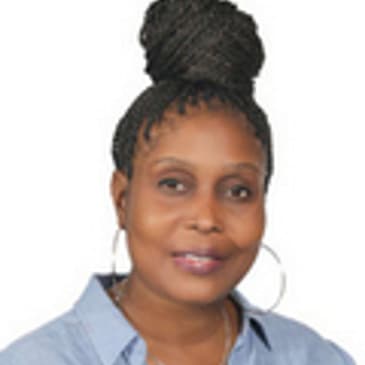
Join us as we explore the insights and expertise of an award-winning, experienced Equity & Inclusion Consultant, an eloquent speaker, a mastermind in workshop development and facilitation – Shernatt Martin. she's not just an educator; she's a beacon of transformation.
Shernatt's educational journey has been a relentless pursuit of knowledge. Armed with a Bachelor of Arts in Sociology focusing on Race Relations and a Bachelor of Education (B.Ed.), and her Masters in Education from York University. she's This profound educational foundation is the cornerstone of her insights, enriching every facet of her work.
So, get ready to be inspired, informed, and empowered. Whether you're an educator, a leader, a changemaker, or simply someone passionate about making a difference, Shernatt Martin's wisdom is your compass. Tune in to Radiant Horizons: Embracing No Limits & Melanin Rich Stories ' as we unravel the layers of equity, inclusion, and education with a true luminary in the field. Welcome, Shernatt Martin!
Welcome to SpeakUP! International with Rita Burke and Elton Brown!
Rita Burke:On SpeakUP! International, we have interviewed community builders from Nigeria, from South Africa, from Brazil, from Mexico. Today, we're back home in our city. As a matter of fact, today we are bringing to you Miss Shernatt Martin, who is residing in Vaughan. Now, Shernatt Martin is the Executive Director of Anchor. She has authored two university courses on diversity and inclusion. She is an educator. Ms. Martin says that she's committed to disrupting and dismantling anti-black racism. To our listeners, help me welcome Shernatt Martin.
Shernatt Martin:Thank you. Thank you so much, Rita. It's wonderful to be here. Thank you, Elton, as well, for the invitation.
Elton Brown:Our pleasure., Black people have this disease that continues to haunt us and that sickle cell the statistics are not good. One out of every 365 Black babies are born with that disease and over 100, 000 people have sickle cell anemia. Can you provide us some information about your book? My Friend Chantel Has Sickle Cell Disease and what is the significance of this book once it was released to our people?
Shernatt Martin:Thank you so much for mentioning that. I appreciate it. I haven't actually spoken about that book for years. So thanks for putting that on your radar. As somebody who has lived with this disease and was diagnosed the age of five. When I arrived in Canada, I was I think I had a very major crisis. And my mother took me to SickKids Hospital in Toronto and at that point she found out what was ailing her child for years before whilst in Jamaica. So she got answers to what this traumatic experience that her little child was experiencing with pain and and inflammation. So the book My Friend Chantal Has Sickle Cell Disease was really just serendipity. It was nothing I planned to write. I was a teacher at the time, and I was teaching in Toronto, in North York in an area known as Jane, just between Finch and and Sheppard it was a beautiful little tiny school called Stylecraft Public School. Shout out to all my Stylecraft former students and colleagues. And it just so happened that there was a little girl in my class. Her name was Janelle, and she missed a lot of classes. She missed a lot of days of school. We didn't know why at the time but after speaking to the mother and trying to understand why she looked a bit lethargic in class, why she didn't want to go out for recess during cold days and why she was missing so much time away from school I found out that she also had Sickle Cell disease. And now, nobody in my school knew this, knew that I carried the illness, but when I heard that I thought it was important for me to let not only my staff know, but my students know. And I did it in such a way to show Janelle that although you are a child with this illness, I'm an adult with the career you can live a meaningful, healthy life, but it didn't feel like it was enough just to let Janelle know that at the time. And I thought, how can I really extend this education? How can I use this to galvanize a community of people who not only understand the illness, but do not make judgments when it comes to children or adults living with the illness. And I had a student teacher who was assigned to me that year. Here's where their serendipity comes into play. who just happened to be an illustrator. And so she was very happy to come on board and illustrate this book for me, which was really the tale of a young girl. And it was really built off of my schooling experience, as well as Janelle, who goes to school and everybody wonders why she's always sick and why she's never here. And she explains to her schoolmates one time she has to be hospitalized with a crisis and Janelle becomes the mouthpiece for the illness and she tells her class and she tells her teachers what she has and they rally behind her and she talks about wanting to be a doctor when she grows up and find the cure for the illness and it's a beautiful story of just coming into the knowledge of self. Loving self, no matter what crosses we bear and being able to use that in such a way as to to bring people in to let them understand the experience, but then not to also have any limitations on your life, any limitations on your abilities. And so I was hoping that book would speak to any child with any limitations or none at all whatever they're going through to know that's. Illness or whatever it is you're going through does not define you. And when you allow something to define you, it confines you. It blocks you.
Rita Burke:Let me interrupt you here just a little bit. I am so glad that you have shed some light on Sickle Cell and you have demonstrated it through your own life that you did not give it permission to limit. your capacity or to limit what you are able to do. So thank you so very much for shedding that light. Perhaps your being here and talking about Sickle Cell. should lead us to the part where we spend a part of this podcast, just talking about Sickle Cell, because it's so important in our community. Let me shift a little bit now, because in your bio, you talked about being a consultant on equity and inclusion. I want you to talk about the need for such a position. Why do you think, why have you been involved in that, please?
Shernatt Martin:So for me I think the discussion around equity, inclusion, diversity and the the importance of not just those three dynamics on its own and together, but also the training, having people being trained and workshopped and discussing it cannot be understated. It's something that is going to, it can change policy, but it can change minds. It's a tool. I think if we do not understand the power behind speaking about the issues around who is allowed to enter spaces and who has a difficult time. Entering those same spaces who was given opportunity and who it's taken from, who was treated differently than others, and the reasons why who can have access and who does not. All of these things are encapsulated in the work of equity, diversity, and inclusion. As a black woman with a disability, I come into the fold in many rooms with three identities. That are sometimes, the invisible disability of Sickle Cell is not seen, but certainly my black color, my melanin, my female voice is seen and heard. And so we have to allow the work to continue the work to be done. In important spaces, whether it's classrooms, health care, businesses financing, banking whatever it is, we have got to ensure that those spaces are not only welcoming, but we're educating people on why it's essential. Why should we know about whether it's anti black racism. Neuro diversity in terms of being on the spectrum or other neuro diverse. Connections that children or adults are dealing with, whether it's a physical disability, an invisible disability, there's so many areas of our lives that we walk through every day that challenge other people when they look at us or work with us. My work as a consultant, we've worked with school boards and provincial bodies and governments and unions as well, is to walk into a space where we know that traditionally the people listening have not heard about. Terms like whether you're talking about inclusion or stereotypes, discrimination, whether you're talking about things like microaggressions, white privilege colonialism these are words, anti black racism that most people don't know on a daily basis. So you have to introduce them to the terminology, explain to them the history of peoples that have been disadvantaged. Whether it's indigenous people or black people around the diaspora to understand why it is we are fighting for the inclusion of certain things. We have to go back to understand the history of not being included. The work is always always changing. It's always advancing. The nuances are advancing. The words that we're inserting into our new vernacular of how we we communicate are always advancing. We have got to make that continue. And I know that. There have been, recent stories in, in, in our newspaper here in Canada around the training and consulting of inclusion, diversity, anti racism. And you always have people who think it's not important. We always have those who believe to be colorblind. We don't see anybody different. We all believe we're the same. We don't judge anybody. I've heard these all my life as a teacher teachers that will say to me, I don't see color. I only see children. And we have to say, no, but you must see color. You must see it because if you do not see that's a black child, a South Asian child, a childhood disability, a child with Sickle Cell, how then do you program for them? How then do you ensure that whatever it is that's challenging for them is met with a positive space, with compassion, with empathy, with love and understanding? How then do you meet those needs of those children? You must see it. You must see it. You must be open to seeing it.
Elton Brown:Can you give me an example of how do you go head first into racism, sexism, homophobia, anti Semitism? How do you address this?
Shernatt Martin:I think what's important is the storytelling of all of those isms that you mentioned is we use a lot of in my consulting a lot of case studies, real true case studies of people and what they've experienced, whether it's in the workplace or school and community. We speak about the truth behind living in those identities, and we address them with the outcome of. Love over all, like love over all, that is the end, that is the beginning, that is all there is to it. But in the between, in the sandwich part of that conversation, is how do we get from point A to point B? How do we understand the histories of people that have been disenfranchised? How do we empathize with people that have been marginalized? How do we understand their realities in totality? So that we can then create a more inclusive society and the pushback is real. The pushback is real. The the inability to want to change or just not wanting to be uncomfortable in that reality of. What's a white supremacy is or what mask toxic masculinity is like all of those things can be very uncomfortable, but we have to tackle that by telling real stories. So people understand that, a slight comment or something that you didn't mean to say it wasn't intentional. We have to understand that even though it was intentional, the impact was felt. And this is why it was felt so intense and impacted two different things. I hear it all the time. What did mean to say that? I didn't mean that, but what you said landed a certain way. And when it lands a certain way, that triggers people. And so this is why we need to understand what we need to do in terms of the realities and the histories of people that have historically been felt marginalized and disenfranchised. And we try to leave it, leave people with a sense of belonging, but also a sense of now, what are you going to do with the information? It's not just for us to just spew out this learning. Now, what do you do? How do you change? Even if it's a simple view that you held before something that you have said, or how do you even go back and feel ownership or accountability for something that you've done or said, whether that's an apology or whether you aren't, it's important.
Rita Burke:I think that's where people have the challenge. The difficulty is. ownership for what they've said, ownership for behavior. But you talked about Sharing this information and educating people through stories. I guess we have a classic classic story right now with an inclusion and diversity workshop that was held in our city and the push back that occurred as a result of that. But I like what you said is that we need to keep on moving forward. We need to keep on breaking the walls down. And we are not going to get everybody on board, but we need to keep on doing the work. So tell us a little bit about your role as the Director Anchor?
Shernatt Martin:So it's, it's a role that I'm deeply honored to hold deeply proud of. It's, I honestly think it's in my DNA. I hear stories of my grandmother from back home in Jamaica and the work she did in community and helping people that need to help in your community. And we didn't have much in Jamaica, but there's a sense of community and always giving back. And so I honestly think it's just something I've always seen and grown up with. So when we moved into the city of Vaughan in 2003, and at that time, I It just seemed like an influx of families from the Caribbean and Africa came at the same time. And and bought homes and were settling. And then in my role as a teacher, we'd get together and go for a coffee or they'd come by we'd share experiences. And we're hearing about a lot of experiences at the time that were affecting black children. And so because I've been a community builder for a very long time. I thought we need to formulate an organization that will not only meet the needs, but advocate as well. Advocate for the community that was really growing in 2003. In fact, now in 20 years later, Vaughan is the city within York region. That has the highest population of African and Black people. That's, we have Markham, Newmarket, Aurora, Thornhill, all of these cities. Vaughan has the most, so they are residing here. So it's interesting to me that in 2003 when we came here, What we're experiencing. And now this is the hub. This is where people are living. And so we have a ton of restaurants and grocery stores. It's wonderful. Which is why I'm so happy that we have a group like Anchor in the City. So really, when we formed it it was actually called the Vaughan African Canadian Association. And the impetus was that we wanted to be a source of information and resource and comfort. And just socialization for families that were moving here. But very quickly, we became an advocacy group. And I think that's our strength, is that we were able to confidently meet with all levels of government, police, healthcare officials, whomever it was, to advocate for the fairness of our children, of families advocate for things that weren't there. And when I moved in, City Hall did not have, I think, one Black person that worked there. We advocated with human resources and said, we need to hire. This is not right. We need to see more faces that are reflective our community. Now it's a very inclusive city hall that we see. We advocated for more racialized people to be hired in programming. We advocated for the hospital here in the city to get training on Sickle Cell disease, so that when children go into merge, they understood what the illness was and we did workshops with nurses and emergency physicians. We've done workshops with the school boards, Catholic and public policing. So having an organization that families know they can pick up the phone, send an email, call us, we'll certainly advocate if they need that support. But also it's an organization that brings people together so that you're not alone. And we know as, as black parents, sometimes you just don't know how to navigate the system. Parents are busy working, children are going to school. How do you navigate a system that maybe your child needs to extra support? Maybe your child is gifted, but the teacher missed it. And they're not in the gifted program. And you're wondering why not? It's just very simple things. Or maybe you applied for a job and you're qualified, but didn't get it. So we go in and we ask those tough questions. We did change our name. I'll say a quick story. Quickly, we were a Vaughan African Cane Association for a good 18 years. And during the pandemic, during the lockdown we found out after George Floyd was murdered, there was a lot of interest in, whose names are on buildings, hospitals, schools, et cetera. And it was a young lady, a young Italian lady, was doing a master's degree. At the former Ryerson University, and one of her her thesis was to really look at the naming of things across the province and the history of it. She happened to live in our city in Vaughan, and she emailed me and she said, Hey, Shernatt Now, did you know that Vaughan was named after a slave, an enslaver named Benjamin Vaughan, who actually owned slaves in Jamaica. And he had a huge plantation, over 400 slaves in Jamaica. And one of his visits from Jamaica to Canada the slaves revolted and burnt down the plantation. But he was a very successful and lucrative enslaver. As our on the backs of our people. And so when he came back to Canada, they named the city of on after him. And you'll see Vaughn, there's so many bonds all over the province, but they named the city after him. So when this young lady doing her master's degree told me the story and she had researched it sent me so many articles on it. We had a board meeting and I said, do we as a black organization want the name of enslaver in our name? Do we as a black organization, working on behalf of black people, want to have Vaughn as a part of our name? And so it was months of deliberating what do we do? What do we call ourselves? Where do we go from here? And a lot of times when we asked community for their input, they said we see you guys as an anchor in our community. You've anchored us, you've balanced us. You've helped us. You've stood your ground. You're unmovable, you're unshakeable. And thus we were, we thought that's the, that's it, that's the perfect name. And so Anchor the acronym is the African Canadian National Coalition Against Hate, oppression, and Racism. And then we broadened our scope to really look at all forms of hate. all forms of oppression and all forms of racism. And so we work with all different communities. We have some wonderful partnerships with communities and cultures from all over the world. We've expanded into parts of Canada. So it's not just the city of Vaughan. It was a lovely sort of transition that was a sort of naturally brought to us and so hence our name change to Anchor Canada.
Elton Brown:Speaking of transitions, you started a theater company and I want to know, how does that theater company help the GTA? How does it help the kids in schools?
Shernatt Martin:Sometimes when you are dealing with a personal issue or it could be a tragedy, we turn to the arts. Sometimes that's the best outlet, to sing about it, dance about it, write about it. And so for me, writing as a child with Sickle Cell disease was my, the way that I poured. The angst and just the challenges of living with that illness. And so I began writing at a very early age, and I remember I was in high school, and one of my friends came out to me, and I remember just watching how many friends this person lost and the attitudes towards them. This was back in the 90s when this was just, there was no such thing as LGBTQSL. It was just, and then I saw friends just being treated badly in terms of their skin color and all sorts of things. And I finished school and decided to start a theater company Ebony Woods Theater Group, and we wrote a play for high school kids to go back and to support them. And the play basically was. Call today's lesson. It was situated in like a classroom. That was the backdrop and it had characters with all different abilities and backgrounds. And we talked about in a real time narratives what it feels like to be. Left out what it feels like to be marginalized and why we need to come together It's a very simple message that we still need today. But it garnered so much support we started to just go in and do this in schools then the ministry of citizenship found out about it They gave us a lovely grant so we could you know get better backdrops and tour and then we started touring around schools in Ontario and then somebody from another ministry heard about us and we were commission to write a play for families living in Toronto community housing to talk about their individual narratives. What feels like to live sometimes with the stereotypes of living in TCH. So that it broadened into that. So theater has always been my love. Writing has been my first love. I think it touches people in a way that sometimes you can't one on one. When you watch something take place in front of your eyes and the characters and the storyline, it changes people's attitudes. And so I always fall back on writing, whether that's poetry or plays, but that's how Ebonywood Theatre Company was formed, and we still do that kind of writing as well.
Rita Burke:No wonder you haven't got time. You spread yourself so broadly and deeply, it's fascinating. But you have the capacity, and so I congratulate you. So now, on SpeakUP! International, we speak, we seek to inform, educate, and inspire and there's no question that you're helping us to meet those goals. For instance, I never knew about Mr. Vaughn. I never knew how the community of Vaughn was named. So thank you for that. Let's do a bit of a segue here. You are an educator and based on what I'm hearing from you today, there's no question that you still educate people and communities. What brought you into that career of education?
Shernatt Martin:I love this question. And teachers will all have different answers about what led them to or why they felt some of them were called to education. I feel I was called to it, but I'll tell you this. I had really great teachers. And I had really horrible teachers and so for me there's space to complain about things in life. Absolutely. But when I had horrible teachers, my sort of justification was and get into teaching was I want to do better than that. I want to give people something better than that. I want to correct that. I want to make sure that nobody gets that. And so I became a teacher to correct sort of the teachers I saw that weren't doing a super job to give students a different perspective of what a teacher, what I felt should be a bit more caring, a bit more intuitive a bit more creative in the way that they teach. And there's a quick story I wanted to share with you about my grade 12 year Actually, no, it was my grade 13 year. We had OAC back in the day. If those of you in the 90s, you know what I'm talking about. But it was an OAC class I took called writer's craft and a part of our last term assignment, which was worth, like 18% of our marks or a huge deal was to go on and research a poet. And then write a original poem that coupled or paralleled the style of that poet you chose. But our teacher gave us a list of poets that she recommended. We had all Emily Dickinson and e. Cummings and all of these poets that I didn't know who they were. European poets and I went down the list and I did some research and I thought, I said to her, Miss Bivel, are there any black poets I can do? And my teacher looked at me and says, I don't think there's any black poets. We're talking the 1990s here. And I said, are you like, there's got to be like I, those, these poems don't really speak to me. Can I research somebody? And she said to me, if you can find a black poet, you can do a black poet. That was what she said. So for the next few weeks, I remember going to the library and skipping classes. Skipping classes because I found a little tiny section in our school library that introduced me to Zora Neale Hurston that introduced me to Langston Hughes that had James Baldwin books and had Maya Angelou books and I was enthralled and I would sit down on the carpet in that library walk going through books and the bell would ring and I'm still going through the books I'm reading from front to back I'm skipping classes I'm just like this I would I never knew black people were writers And I never knew that there are wonderful books that were written by authors that look like me. And so I met the challenge that Miss Bivel gave me and I did my research on Langston Hughes. And when I presented to the class and shared his poems and read them to the class, even my teacher was so impressed because she too was like, Wow, I didn't know the history of the Harlem Renaissance. I didn't know what that was. And she was so impressed that she submitted my poem. into this anthology that was published in York Region and my poem made it. And so as a little black child in grade 13 to then see my published work in an anthology of a black man, his stylistics, it changed my life. In fact, the book that I took out of the library And I'm going to be honest about this. And I'm, this is a part of the story. I never returned it to that library. Like it was, it meant so much to me that it's in my basement today. It's in my, and all the pages are curled and underlined and highlighted because it literally saved my life. And I tell my children about today. I said, if I didn't read this book and do this assignment the way I did. It would not propel me to be a teacher. It would not propel me to work in the community because what I saw them when I said to myself, what are you complaining about? When back in those days, they had nothing. They had nothing. Black people in those days had nothing but their voice and they used it. They weren't allowed to enter some clubs from the front entrance, but they used it. They weren't considered to be the best of the best, but they used that and I thought if that lit a fire in me, I was like, I was writing every day and I was going through poetry and I said to myself, I'm going to be a teacher so I can teach kids that yes, black people do write books. Yes.
Rita Burke:Truly amazing, fantastic, wonderful story. I am curious, whatever became of that teacher and were you ever able to say to her. Thank you for doing this for me.
Shernatt Martin:100% 100% In fact, our relationship changed so much after that, because there was this respect level that I had that a she not only you could say she should have known better, but no, she allowed me to do it. And she submitted out of everyone in the classroom, my poem for the anthology, and what that meant when she actually when I went into school, I think it was a few months later, she was there with a copy of the book, which I still have. And she said, I want to let you know that you got published and I still have a copy of that. And I said, Miss Bibble, this has changed my life. Like I just to see my work in something and just what it meant to me for her to just believe in me. And to give me the space to be me, to show my identity from like the class. It changed my life. So yes, Miss Bibble, thank you. She's heard a lot of the thank yous, but I tell the story to my students all the time about what the importance of seeing yourself. The importance of identifying in something that makes you want to motivate to do something great with your life. It is essential that children get these opportunities to read these books, to see people in different perspectives. That for me was a turning point. And really, it was behind me becoming a teacher when I graduated. Here we are today.
Elton Brown:That's great! Food defines us! I want to know, I have two questions. One do you cook?
Shernatt Martin:100%. Yes, I do. I do.
Elton Brown:What is your go to dish? What dish do you like to cook? And everyone, are smacking their chops. And you are extremely proud of this dish. So tell us a little bit about that dish that you enjoy cooking, eating.
Shernatt Martin:So I have to go lean on my Jamaican and Caribbean heritage. A grandmother who I grew up in Jamaica. I even came to this country, and I came when I was five. We were sweeping up the yard and we were rolling dumpling and we were cooking and seasoning up chicken. I was taught that for very young age and so my go to meal that people come to and I love because it just reminds me of back home. It gives me it's like a comfort food for me is Ackee Salt Fish, which is a traditional Jamaican breakfast. But the way that I make it with the sides of what we call fried dumpling. And everyone who tastes it says to me that I make it differently, which I do. I add a little bit of little secret sauce to to make it really well. A little bit of butter and a little bit of milk, a little bit of milk will make it fluffy and just enough baking powder. So it's very fluffy. It's a little bit, it's very the inside is cooked, but the outside is a little bit crusty because of the butter. So Ackee Salt Fish with fried dumpling. My go to meal, a hundred percent!
Rita Burke:Mouth watering. You're missing the most fun.
Shernatt Martin:I just gave out a little secret. Yes, the milk and the butter. That's it. Add that to your flour!
Rita Burke:I am wondering if you would share with us the best piece of advice you've ever been given.
Shernatt Martin:Okay, how can I start this story? Because I don't, I want to, I'll get very emotional when I talk about this best piece of advice that I've even shared with students and my own children. It came from my mother. It's a very simple advice. The way in which she taught it to me, I think is worth mentioning. I remember being in high school and I didn't want to finish school. I was very sick with crises and I was, there was a time period where I was in and out of hospital so many times. The doctors at one point thought I was going to lose my eyesight. I was having crises in just beneath or behind my eye socket. And I was having crises in my brain a lot, in my head. And it was leading to my eyes beginning to roll back and I thought I was going to go blind. There are times when I was growing up where they didn't know if I would live. They had given me the age of 16 with Sickle Cell disease. I was getting very sick in high school. And so I would say to my mother, what's the point? I don't want to go to school. I want to quit. Like I'll just find a job and live out the life God has for me. And I didn't want to do anything. And I remember my mother came into my room and she opened my closet and she's come here. And in my closet was a mirror. She said, look in that mirror. And I'm there gazing in the mirror and tears rolling down my face. She said, do you love yourself? And I was like, shrug it off. Yeah. She goes, do you love yourself? Yeah. Do you love yourself? And I said, mommy, I love myself. She said, you need to sit and I want you to stay in this room and look in that mirror and come out when you love yourself. She said, I'm going to tell you something. The only thing that's going to get you out of this rut is the ability to love your self. Whatever Sickle Cell is not you. That is not who you are. You are Shernatt Martin! Love her because God has a plan for your life. Learn to love her with everything that goes on in your life. Love yourself. And I sat in my room and I looked in that mirror. And I stared at myself. I looked in my eyes and I began to ask questions. What are you going to do with your life? What if you quit school? What will you do? All of these questions and tears streaming down. I exited my room. I said, Mommy, I love myself. And that was it. That was literally it. It just. It, something just popped in me and the love for myself that the love that whatever she did that day, I started to treat myself differently. I treated people differently. While my friends were out dah, I had a different mentality. I just thought, I'm not going to do that. I'm not going to start smoking because I love myself. I'm not going to drink. Why would I drink? It ruins my body. I love myself. All of these things, all of a sudden now, the reasoning behind why I would do or not do things was because I loved myself. I wanted to make myself happy. I wanted to live my divine purpose. There was a love of self that is translated. And I think Even that has helped me in community. Because when you love, you can give love. When you love, you can reflect love. When you love, you're confident. When you love, you can enter rooms with prime ministers and ministers. Because I love, I walk you with a sense of love. I know me, I love me, accept me. There's no timid girl here. There's no shy girl here. This is love that you see. This is love in front of you. And that is the advice that I give my children and my students all the time. It begins and ends with love. Love is the beginning. Love is the end. You enter life because of love. You enter the next phase of life because of love. Love is everything. When you love yourself.
Rita Burke:What a profound lesson coming from
Shernatt Martin:Had a good mama had a wornderful mama!
Rita Burke:At a wonderful age. It has certainly grounded you and brought you into the person you are today, I believe. I really believe. I have a question that I'm burning up. I know Elton has questions as well. But I'm burning up to ask you. Tell us about Sharon's life between the ages of... 15, 16. If you haven't told us before.
Shernatt Martin:So 15 and 16 was really those years where I questioned what I was going to do in life. But, the story about Miss Bivala turning myself around and really understanding about my future came to be, but I was a very quiet introverted child. I value time alone. I reflected a lot. I wrote a lot. Poetry, everything quotes. I was an avid reader. That was my solace. So because of the illness, I missed a lot of things in school. I missed my prom. I missed my high school graduation. I was sick for a lot of things. So even friendships, I would make a friend this week and I'd be. in hospital for three, come back and she had a new best friend. So it was, there was a lot of trying to be flexible and fit into certain things and understanding that my, my journey was different from many other people's journeys. My teacher would come and see me at SickKids Hospital and bring me a teddy bear and a card from the class. Like I was that student that everybody felt sorry for, so my teenage years were just, Really filled with being very introverted spending time with myself, but I think it formed me. It really did. It really gave me time to sit with myself and my thoughts and to really plan a life for myself that I wanted. Despite what doctors kept telling me, Sickle Cell, you may not live till this and it was almost like I'm going to, I'm going to show you that I'm going to do better than what you think I can do. And going to university and, having two degrees and being sick in hospital with crises. And I remember at one time faxing my essays from the hospital, the nursing station, when fax machines were a thing faxing my essays so I wouldn't lose credits. Just being very thoughtful of this illness is not going to stop me or slow me down. I'm going to continue. So I think in those years of 15, 16, it's shaped my work ethic. It shaped my identity. It shaped my vision for what my future would look like.
Elton Brown:You are a motivational speaker and you talk about love and how powerful that is. How do you motivate the children that you interact with and do you see the results from your motivational speeches?
Shernatt Martin:I can only hope. Honestly, I can only hope that I do. And they don't have to listen to everything, but hopefully they catch a little something that applies to them. But, yes I am hopeful. I, every year you get a new classroom. I'm filled with hope and wonder about what these children will be and their lives and the small role I'll play in them. And I think for me, I just see every child is having. Something just wonderful in them. There's a trait that is something as teachers. We have to find and help them nurture. Not every child knows what it is. Sometimes we see it. I can walk into a classroom and scan the room and literally do like just a quick little assessment and know who I need to reach a little bit more and who I need to spend more time with. And all of those things you can quickly assess. And that year sometimes shows you that. So for me to motivate my children is to see something special in each of them. Thank you. To nurture it, to curate it, to to bring it to light, to honor it, and help them to do the same for themselves.
Rita Burke:You said, Shernatt, that community involvement, community work runs in your DNA because you saw your grandmother doing that. I have this strong feeling and suspicion that perhaps success also, and determination, and resilience. are also grounded and tattooed and etched in their DNA. Thank you for educating us. We know that racism exists. We know that our community In Toronto, in Ontario, in Canada, we've gone through challenges, difficulties, oppression, the works, but I also believe that our trajectory, we have made some progress. I'm inviting you to tell us some of the positive changes that you have seen in our community.
Shernatt Martin:Absolutely. And, I think we have to Really spend some time in, in that reality and that notion of we have done well, we have moved the line a little bit. We are making progress. I think if you become jaded and not really think about how far we've come, you end up being a very bitter place, a place where, the energy is just weighing you down. So I think we do have to be grateful for these small incremental changes along the way. So for me I always think about. The changes we've made, simple changes, whether it's an education with certain de-streaming of different classes or the hiring of so many racialized people being promoted to administrative roles, which I didn't see growing up. I know how many people my generation can say. They've had a black teacher, a black VP or even a secretary that was black or a caretaker, like whatever in the school. We're now seeing that. And that's through my profession, these changes that I'm seeing. But I'm also seeing it in terms of the way that people view. The world and how they think about me as a black woman opportunities that have opened up just give it lending voice and being open to understanding the histories and the reality of people that are melanin rich like myself. I think. We couldn't use words that we use right now. We couldn't do certain things when I was growing up in the nineties that my children are benefiting from. And so the work might be heavy. The load is heavy, but you do in your generation see a little bit of change. And all it is that you almost have just passed. Keep passing that torch. And I'll tell you, sometimes I get so laden down with the work ahead. And I have to remind myself that my ancestors Had it so much harder and fought for me to do what I'm doing now. So my job is to do it for my daughters, son son, like that is my job. It's not necessarily complain about it. It's just to go and do it because it is essential. So I see changes. Simple changes like I mentioned the hospital that used to tell young black boys when especially young black boys who had Sickle Cell when they came into E-merge that they were only seeking drugs. Because one of the treatments of a crisis is pain medicine, IV fluids, et cetera. I remember a time when black men are being turned away saying they're drug addicts, seeking their own care for their illness. And so now that we're going to hospitals, telling them that this is the story of Sickle Cell. I know that the Sickle Cell Association now has a private member's bill that went through, which is creating a protocol throughout Ontario hospitals, that they now have a protocol as soon as you step in and say, I have a Sickle Cell crisis, immediately you're getting oxygen, you're getting your pain meds you're getting IV treatment, you're getting a room to lay down and rest, and the discrimination and the stereotyping has gone to the side. That wouldn't have happened had groups not fought and fought. Again, we're moving it forward. So we all have to do our small part. This podcast is doing your part as well. What you're doing and bringing forth, speakers with different experiences and backgrounds, just to give little nuggets of motivation and information you're doing a part. So whatever skillset we have as human beings, use it because you don't know who will benefit from it. And you don't know how much more you are just bringing that line forward. So don't sit on it, use it. And that's my philosophy.
Elton Brown:I loved this term that you used earlier. Melanin Enriched! I've never heard that before and that's, I always catch these words, these combinations and this is the one for this podcast. You have talked about so many things, your accomplishments, the effects of your hard work on so many people. The students that you are teaching and motivating you're a writer, I'm hoping that you will write another book, which would be great. I'm sure you have one somewhere in that mind of yours, but unfortunately you're doing 15, 000 things all at once! I want to thank you for taking the time out of your very busy schedule to sit down and have a conversation with us here at SpeakUP! International.
Rita Burke:Thank you for being a community builder, Shernatt Martin, I certainly appreciate what you've done by joining us today on SpeakUP! International.
Shernatt Martin:Thank you so much, Elton. Thank you so much, Rita. It's been a pleasure. Thank you for the work that you do and continue to do in our community. So much appreciated spending time with you. Thank you for the opportunity and thank you to your listeners as well.
Thank you for listening to SpeakUP! International. If you would like to contact Shernatt Martin. Kindly provide your name and email address and send it to info@speakuppodcast.ca. Please state in your email, you wish to contact Shernatt Martin. Would you like to be interviewed by SpeakUP! International? Please drop us a line containing your name, company, name the name of the service you provide to your community and email address to speakup@speakuppodcast.ca. You can reach us using Facebook, Instagram Twitter and Linkedin. To connect to our podcasts use Spotify or your favorite podcast platform and search for SpeakUP! International You can also find our podcast using our web address www.speakuppodcast.ca. Our logo has the woman with her finger pointing up mouth open Speaking UP! At SpeakUP! International we aim to inspire to inform to educate and enlignten!