
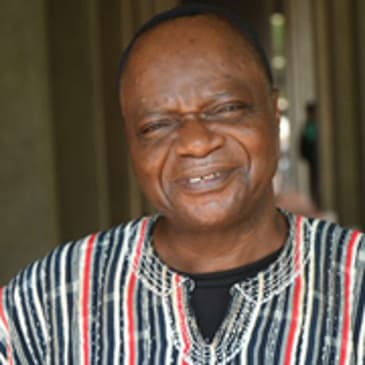
Join the conversation with the esteemed Professor George JS Dei loving known as Professor Nana Dei, a beacon of knowledge for Black African Canadian education, as he graces our platform with his insights that meld the essence of resistance with the transformative power of education. We venture beyond the confines of conventional learning and into the heart of community empowerment, where Professor Dei amplifies the voices of the past and the promise of the future. His perspective as a traditional Ghanaian chief brings a unique dimension to our discussion on the crucial role education plays in shaping identities and promoting Diversity, Equity, and Inclusion.
The episode unfolds a tapestry of topics, starting with a profound exploration of the Center for Integrative Antiracism Studies, which I, Sherry Razak, had the privilege to co-found. Here, we delve into the center's mission to challenge anti-blackness and systemic oppression and highlight our collaborative efforts across the African continent. Professor Dei's reflections on receiving honorary doctorates not only honor his work but also the legacy of those who have paved the way for such achievements. This conversation is a testament to the center's impact and the ongoing fight for justice within academic circles and beyond.
Wrapping up, the episode extends an open invitation to engage with Professor Dei through Speak Up International, an initiative dedicated to fostering critical awareness and amplifying community voices. Whether you're an educator striving to carry your identity with pride or a listener eager to contribute to the dialogue, this episode is an incitement to action. Learn how to connect and share your story, as we provide the resources and support to make every voice heard. Join us on this journey of education, resistance, and community, where every story matters and every contribution counts.
[00:00:00] Ellington Brown: Welcome to SpeakUP! International with Rita Burke, and Elton Brown!
Nana Dei is a globally celebrated professor at OISE, University of Toronto. He's known for his advocacy work in Black African Canadian education. In 2007, Professor Dei was installed as a traditional chief in Ghana. And with this honour, Nana Dei gets a stool name. For our discussion today, he prefers to be called Nana, and on SpeakUP! International, we seek to inform, inspire, and educate!
I have no doubt that Nana Dei's story will meet those objectives. Glad to have you with us today. Professor Nana Dei! Glad to have you with us!
[00:01:15] Nana Dei: Thank you. Thank you. Thank you for having me. It's a pleasure.
[00:01:19] Ellington Brown: It is an honor to have such a scholar with us this morning. How do your studies in anti racism, black youth education, African, social, racial, and anti colonial.
How does all of that come together and how do you use that to promote DEI?
[00:01:46] Nana Dei: Okay. First, first of all, um, let, let me recognize the, the, the land and the space in which we are. And that's, and that's because, um, uh, I think it's in Mozambique, right? Uh, but I think in other places, right? We teach students that every classroom is a space that people have to fight to liberate.
So we talk about the land in which we are and how we have to fight, whether to keep our land or to liberate ourselves from the land. So it's very important. But also I think to give a shout to the ancestors, uh, African ancestors, uh, because I think they are those who give us the spiritual strength and the backbone to do what we do.
And so in the late, in the words of the late Maya Angelou, right, uh, I come to this podcast bearing the fruits of knowledge which have been given to me by my elders and my ancestors. So I just want to recognize that. Uh, and thanks for for having me. So to answer your question, I think, uh, to me, one of the things I have realized over the years that these things are connected, right?
Questions of anti racism, anti colonial thought, right? In this case, speaking about African. and black indigeneities are all connected in making this whole, because we are dealing with questions about knowledge. We are dealing with questions about history. We are dealing with questions about, uh, how we fight, resist, and how we reclaim our humanity.
So for me, all these things fit together, right? Uh, you cannot be a black scholar. You cannot be a black educator without being a resistor, because our ancestors were resistors. We are here because of the resistance of our ancestors, and this is why it's so important for us, and I teach my students that, that when we get into certain spaces, we cannot just simply assume we got there because we are too smart.
That's why we got there. Of course we know we are smart. That's not the point. The point is that there has been traditionally some gatekeeping processes that have kept some of us out of the door, and we are still fighting to break those walls down. So when we get into those spaces, we need to remember that history of resistance that got us to where we are and continue the struggle to open the doors for others also to come through.
And this is why you connect, right? You can talk about our existence, but what does blackness mean? Blackness sure is a conceptual construction, right? It's a concept, but it's also political. It's also an awareness. Right? Of who one is. It's about identity, right? And it's very important to bring some consciousness to that identity.
One of those consciousness is also to see that we cannot talk about these issues without talking about anti blackness. We're not talking about racism, we're not talking about how racism intersects with other forms of oppression, whether it's gender, sexual disability, class. And so you see these issues connect, and I think when we speak about that, we are also decolonizing, and decolonization is not just about the land, the land is very important, but it's also about the mind,
to come to that critical consciousness. for this. That the mind is so important also, because the mind allows us to ask certain questions about our absences, omegans, omissions, and negations, the devaluation, the dehumanization of our existence. And that's why that critical consciousness, right, that we talk about, Fanon talks about coming to that consciousness.
Ngujiwa Thiong'o talks about decolonization as decolonizing the mind. Greenmark talks about unchaining our minds. And it's very important for us to connect these issues and we can only connect these issues if we understand where we're coming from, where we are now and how we are going forward. That is to me, it's.
Talking about the totality of our lived experiences as black and African peoples. We reclaim our history, we reflect on our present circumstances, and we project onto the future. That, to me, is speaking about the totality of the African lived experiences. And lastly, and this is very important, right, and it's very important that, I think I say people, we critique the present and use that knowledge to To think about the possibilities of a new future.
So it's not enough to just simply to critique, but to create the awareness, to use the awareness, to think about how we find solutions to our current problems and be able to project a new future, because our struggle is about knowing our past, understanding our present. And working towards a new feature.
That is our story. And that is our struggle.
[00:07:40] Rita Burke: Well, Nana Dei, I feel as if I'm at an educational conference and you are the keynote speaker and I can continue listening to you. And you have referenced so very, so many very important points in this short stint that it's going to be truly, truly fascinating.
You talked about Ngugi and you talked about Fanon. And you talked about something that Garvey said many years ago about taking the kinks out of our mind and not out of our hair. And you know that's profound and you captured it beautifully. So I want to go back to a question that what it is that led you in the direction of education?
[00:08:27] Nana Dei: Yeah, I think to me education is about everything we do. Right. Uh, I mean, there are all these you talk about. It's about the ways, the options and strategies through which we come to understand our world and act within that world to bring about change, right? So I'll answer your question in two ways. One is to me, uh, look, I know when growing up, my, my, I was told my mom and my dad always say, you are going to be a professor one day because they said, I like to, to speak, I like to talk, right?
And, and it's true. I think my students, I remember some of my students at the University of Tulsa. Or, uh, George, that time I was in Nana, right, you'll see, uh, George never saw a microphone. He didn't like it, right? If he saw the microphone, he couldn't speak to it. So to me, there's a passion, right? Because I have, I'm very, very passionate about the things I feel.
I feel strongly. And that to me, you cannot be an educator without being passionate. You must feel, you must love the work that you do, right? So I came to this sense through my upbringing. That to me is very, very important for us to understand ourselves, to understand our communities, and to understand our world, in order to bring the change.
That is very, very important. Right. And so, with that upbringing, when I started my, my, my, my schooling, right, these were questions that I was thinking about. Let's give you a bit of history too on to this, right. Listen, I, I went to high school, uh, in Ghana, called Ghana National College. This was a college that was established by our late president, anti colonial president, Kwame Nkrumah, and he used part of his own funds to establish the school because some of the students who protested colonial rule were dismissed from school and he wanted to create a space for them to get their education.
So the history of that school, when you go into that school, you are told about that history. How can you get into that school and not think about the importance of resistance? Because you are in a space where people who resisted and who were punished were given a second chance at education. So you must be privileged.
You must be blessed. You must have the wisdom and the knowledge of that space. And let it guide you in your work. And so all these things, to me, go together in terms of coming to an education. And when it comes to education, the other part is about questions of schooling itself. The question of schooling, right?
My initial work was on development studies. But I realized that, for example, right, uh, having lived in Canada, right, um, the
way, what happens, say, in Africa, and how Black peoples, African peoples, say, in the diaspora, are treated, are connected. When they see images on TV about so called starving babies that Africa is helpless, they can't get it out together. It relates to how they treat our King's folk here. And it's very important then that we lift up our young learners in the school system to be proud of their identity as African peoples.
To be proud of who they are, to recognize that history, and to stay strong, to stand with their head on their shoulders, is very important. And this is why to me, it leads to me, then to connect education with schooling, because schooling is so important, right? And it cannot be left in the hands of simply educators.
Because where I came from, where I grew up, your mother, your father, your uncle, your nephew, the wider community were all educators. It wasn't just the teachers, right? Sometimes you got the greatest punishment, not from your mother, not from your father, not from your teacher, but the neighbor.
[00:13:01] Rita Burke: Yes, from somebody in the community, yes.
[00:13:03] Ellington Brown: I know how passionate you are about education and the importance of making sure that everyone has the same footing when it comes to being educated. If they want to be a teacher or they want to be, you know, an electrician, whatever their passion lies, they should have the opportunity to do that.
And I want you to talk about a notable award that you received, which was the Whitworth Award for Career Research and Education. Can you talk a little bit about that, please?
[00:13:42] Nana Dei: Yeah, I think the Whitworth is given to the Canadian educator who has made some impact on Canadian educational policy. So, um, to me, to recognize that at least my work, right, and when I talk about recognizing work, It's not just simply my work.
I think I'm standing on the shoulders of the community. I stand on the work that I did with my students. So it's a collective lesson, but I think so to me, that is a recognition that at least we are doing something that is worth recognizing. And that's very, very encouraging. Right. That's very encouraging because I think as an educator, uh, we need to make an impact, right?
We need to make an impact, not only on our learners, but on the communities. Because education, as I said, it's about everything that we do, how we come to understand, how we come to work for change, and how we come to promote new futures. Because sometimes what happens is that others want to design features.
For some, and we have to have the power to design our own features, and we can do this through education. So the extent to which my work, which is a collective work with assistance from others, is being recognized with an award, that it has made an impact. That is, that to me is very, very rewarding, and I'm very, very proud of it, right, and I thank the ancestors.
Uh, for it. One of the things you said earlier was about every child should receive education. Yes, everybody must have education, but what type of education are we talking about? And what are you going to do with that education? Those are the critical questions, right? It's very important for us to talk about critical education, education that makes us conscious and awareness of who we are and how we work to bring about change, how we work to promote our communities.
Right. Unfortunately, what is happening now is that sometimes rather than education becoming a right is becoming a privilege because of the high cost of education. And then we need to be concerned about that. Education should be a right. It should not be a privilege, where some who can afford it only get it.
We all deserve to get it.
[00:16:14] Rita Burke: Nana Dei. You made a statement in response to Elton's question, and that is how we work to promote our communities. And on SpeakUP! International, we interview people, we call, we label community builders. And that is absolutely critical. We, we, we, we handpick the people that we chat with on SpeakUP! International because they are, they are definitely doing work that promotes our community.
And I appreciate what you're doing. Now, you're known as one of Canada's foremost scholars. on race and racism. Please tell our audience what you did to get this title. And that's a tongue in cheek question because I know what you've done.
[00:17:05] Nana Dei: Right. No, I think it speaks to the question that Elton was asking.
I think, um, when people read your work and people continue to cite your work, right. And people know what you're doing around questions of race, anti racism, African indigeneity. and that you are one of those key theorists, key educators in the area, right? It starts to reason that at some point people would say, you know, you cannot talk about this issue without mentioning at least one of these as among other names, right?
And so this is how to me it's very, very important, uh, in that. But I want to come back to where you started your question from. What is the issue about community, right? Sometimes there's a feeling that communities are given to us. No, we build communities. We don't pluck communities from the sky. We build them one brick at a time.
And this is why we have to create communities in the plural, right? You know, you know, the saying, there's a saying that it takes a village to raise a child, that African saying. Many people say it, but I don't think they understand what it means. Of course it takes a village to raise a child. We all know that, but you must have that village to In the first place, you must create it.
If you don't create that village, you're not going to raise a child, right? And this is why we have to think of our communities, how our histories are connected and intersected, right? When we talk of the Black community, for example, we are not homogeneous, we are heterogeneous, but we are connected. We are histories that are shared, and these histories are shared.
It doesn't mean they are similar histories, but they are shared. They are shared across land spaces, just as we talk about black and indigenous relationship, right? We have issues of colonialism. We have histories where, for some, their lands were dispossessed, others, they were taken away from their land.
This is about connection. We are connected, right? So we have to talk about those connections. It's about how these histories are connected and how we build histories, we build communities that strengthen each other rather than pull each other down in that sense.
[00:19:41] Ellington Brown: There were some words that you used and you've used them more than once and one was encouraging and the other is feelings and I think that kind of all equates to passion and how this passion is given to other people in our in our community, and I do agree with you community is more of a concept. It's not something that. Okay. You have all of these people that live in this one area. So that's a community. No, that is not a community. It's it's knit through these feelings and encouragement. Which I know of, I know well because if I did something outside and one of the parents didn't like it, they'd beat my behind and then send me home.
And then when I got home, I didn't want to tell my mother because I knew I was going to get another, another whipping. That to me, is community because everybody is taking part in molding the the upcoming generation. So can you explain the significance of your role as director for the Center of Integrated Anti Racism Studies at the Ontario Institute for Studies in Education.
[00:21:03] Nana Dei: Yeah. Um, to, um, just to come back to that question that we just want to highlight a point at me because it's very, very important. Right. Um, look, growing up in, in Ghana and I think many African coaches, and I'm sure in the Caribbean and in that, that's where one is taught about the importance of community.
It doesn't mean the individual is so important. The individual is important insofar as he or she is linked with the community that they are part of. And this is why as an indicator, because our communities hold us, they have our back, we cannot put them under the bus. We always have to know our responsibilities to the communities, because at the end of the day, when we get into trouble, when we have to face the The, the issues that we face is a committee that are going to be there to support us.
So we must never forget that. Now to the question about the Center for Integrative Anti Racism Studies, right? This was a center that was formed decades ago, uh, and, and three of us, uh, myself, a colleague, Shereen Razack, and the late Roxana Eng were at the forefront of getting that center. We were more concerned about a question of how schools take up race, racism.
Right. That we need a space. We need a center that to be a mouthpiece to speak. Of course, there are professors who speak on that, but it's also very important to have a center that allows students, communities and researchers to work together to promote questions of racism and how racism intersects with other forms, difference and oppression.
Right. So it's a center that I lead, but I work with students and other faculty. Right. Right. And the directorship means you offer the leadership, right? There are others who have also been past directors, but you offer leadership and work with others. My conception of a leader is that a leader should be able to take initiatives, but a leader must also learn to follow, right?
You take the initiative, but you also learn to follow because the others you are working with also have something in their head. They have some knowledge and not everything resides in you. You know, the Bobop tree, the Bobop tree, it's so huge, your arm alone cannot embrace it. You have to hold others to embrace it, right?
So that's my conception of leadership. You take initiatives, but you also work with others and learn and follow from them. So this is a center that is at the forefront dealing with questions of race, anti racism, anti blackness, right? But we also talk about questions of other oppressions and also talk about questions of indigeneity.
Right. That there's a need to talk about, to me, blackness and black is also indigenous and indigeneity. The two are not separate. They are always intertwined. Because I talk about indigeneity in the sense that, look, we do have African indigenous, right? 1492 is not the beginning of the black experience. The black experience didn't start with 1492, right?
We have to go back to African indigeneity, and there is an African indigenous conception of blackness, which is outside of the white dominant construction of whiteness, which is seen as the counterpoint. Now, if we look in African indigenous lexicon, blackness stands for so many things. It stands for courage.
It stands for red. It stands for resistance and so forth. It was never associated with issues of criminality.
[00:25:14] Rita Burke: Never associated with negativity.
[00:25:16] Nana Dei: Yes, exactly. It wasn't, right? So we have to separate that from the way with, with this particular conception of blackness, which is made as a counterpoint of whiteness. And that is a problem, right? Yes, we must critique that. We must critique that. But we must also recognize that Black experience did not start with 1492.
[00:25:47] Rita Burke: We've got a lot of work to do, Nana Dei. We've got a lot of work to do. And you, and you are You're leading the charge and we thank you for that. You're leading the charge. We thank you for that. And I am glad you referenced the Bobop tree because I'm in the process of writing a children's book and I'm including that in the book.
So thank you. Thank you. That, that, that reaffirms that I should include that in my book. Now, you were born in Ghana, but I see that your work has transcended boundaries, not only in Africa, but globally. Can you tell us some of your collaborative work in Africa, especially South Africa, please?
[00:26:31] Nana Dei: Yeah. Um, you know, you cannot be a scholar without doing, uh, research and collaborative work.
And so that has taken me to other places like Nigeria, of course, Ghana, where I was born, and then South Africa, and also Kenya, right? Uh, so part of the collaborative work is not simply in these spaces, helping to mentor young students. Right. So you, you, you add a visit, you get a visit to this space, either to speak or to, you will go there to do research and you come across students.
They get your contact in the established relationship with you and you always communicate with them, giving them advice, but also you meet faculty who want to do research work with you who want to publish with you. Right. So I have done publications with my African colleagues who are based on the continent.
And because I, part of my work takes me to the continent, right? Uh, I have publications that I've done with them. I've researched that ongoing. I mean, one of the things that we were talking about, Bobop tree, right? It's all about our elders, right? One of the things I'm doing now is about elders and eldership, African elders and eldership, the importance of elders, right?
In our communities. Right. And so that work, for example, took me to Ghana, to South Africa. Right, to do that. And so when you talk about the connection with South Africa, right, it's longstanding. I mean, I have colleagues, friends who I work with in South Africa. My work on African elders has a component dealing with South African elders, right?
I've published with, with colleagues at the University of, uh, uh, uh, South Africa. Right. And anytime that we hear that I'm being invited, there's somebody somewhere who wants me to say, is there, is it possible to make a detour on your trip so that you come and speak, right? And that's what, this is why my connection is.
And I think doing this, why, uh, the, to, to receive an honorary doctorate from the university of South Africa has been a high point for me and coming from, coming from it, coming from an African university, university, the largest. It's an, it's an honor and, and recently to that honor was extended when I also got news that I'm going to receive another honorary doctorate from Algoma University in Ontario.
Right. So which means within this year, I'm getting two honorary doctorates, which is a blessing and I'm thankful to the ancestors and to my students and to all the people who have helped me along the way.
[00:29:07] Ellington Brown: I think it's important that we are recognized. It's because that in itself fuels individuals to They now know they've reached a certain level.
So now that means now they've got to move maybe a little harder, a little faster, because they've been recognized at this point. At this level. And so you talked about the elders and collaboration. And I think those two things kind of go together because that's where you're reaching to get that knowledge from.
You have contributed to the retheorization and anti colonial theory and African, , so how, How does the collaboration help you make those contributions?
[00:30:00] Nana Dei: Yeah, I think, see, we do collaboration because we don't, because we believe that not everything resides in our own heads, that we learn from others.
So in collaborative work, you get ideas, just as when you're a teacher in the classroom, right? Uh, you have, the students who come to the classroom, right, are coming from different places. They come from different experiences, they come with different knowledges. So you create the space, the cycle, right? That allows all these knowledges to be soaked in.
And you work with it and that. And you cannot be in the classroom and hear people speak about their experiences. Hear people speak about their stories. And not also be aware why it's important for us to decolonize, right? So it's these interactions, the experiences. The hardships, the struggles that people go through that informs one to think about how we create a better world, right?
Nobody's perfect. Nobody's perfect. But I always talk about the humility to learn when you come into a space and you are very arrogant. You leave that space knowing nothing, because you were so arrogant, you thought you knew everything. But if you are very humble, you go into that space with that humility.
And when you get out of that space, you know more. So it's through that humility that has allowed me to think about other ways of knowing, other ways of thinking through our existence, and to be able to speak about these issues about coloniality. anti colonialism, decolonization, because students who speak about it, colleagues who speak about it, and then you take those ideas to and also think through your own experiences your whole life, right?
One of the challenges we face as a people is that we are not given the power to tell our stories and this is why now we need to reclaim. The challenge has always been how do we get that power and we have to reclaim the power to tell our own stories, to tell our own stories. in our own terms, in our own knowledges.
And it's very important. So one of the things that I speak about, I write about is the power of multiple or multi centric knowledges, right? There are multiple knowledges and it's very important that we validate them. We allow the knowledges to contest with each other and come to a better understanding.
And lastly, it's also a question about how we talk about achieving success. Right. No, we will talk about success and the individualize it. Right. That is all the learner. Right. Success is the product of your parents, your communities, other students in the classroom, and your teachers. They are all part of contributing to success.
That's why we cannot talk about success as if it's individual. Success is always collective, right? And then also to talk about success in a way that recognizes that you can be successful on the test course. You may get A, A+ but you are very lousy when it comes to community responsibility. That to me is not success.
That to me is not success. So, success has to transcend beyond the individual to the community. And this is a challenge for all of us, right? This is why mentorship, for example, to me is a big thing of mine, mentorship, to mentor the young ones. Because as you mentor the young ones, they also mentor you. It's a two way process because the young ones will also mentor you because they will speak about their experiences.
That you don't know because you are not experiencing it. And that to me is mentoring. They are mentoring you in that process. And it's very important to see it that way, that this is how knowledge is created. It's shared, it's accumulated.
[00:34:40] Rita Burke: Yeah, I like what you said in terms of when the students enter your space, they're not coming as clean slates.
[00:34:51] Nana Dei: Yeah.
[00:34:51] Rita Burke: They're, they're bringing experiences and knowledge, it doesn't matter how old they are. Yes. To the learning, to the learning environment and the open. Minded or humble educator could also learn from those students.
[00:35:05] Nana Dei: Yeah,
[00:35:05] Rita Burke: I like that in particular that sticks with me now recently, Nana Dei. You were installed as a traditional chief in Ghana.
I'm really excited about this. Please explain the significance of that ritual.
[00:35:22] Nana Dei: Yeah. No, it's actually, it was in 2007, right? Uh, when I was installed, uh, as a traditional chief, um, I know when we talk about chiefs, we talk about chiefs in the hierarchy, right? Uh, because we have, we have, we have different, there's a permanency, the main chiefs and then the other sub chiefs in there.
And that was made the Jahsehine, right, and, and, and Jahsehine, uh, it's, it's a big, uh, uh, status, right? Uh, uh, and there's an honor that comes with it, but, uh, I think it's also related to, uh, it's within the family, the lineage, right? That, uh, certainly maybe some tools that are attached to them, right? And, and so when, when your uncle, uh, passes, there's a transition.
But your question is more about the ceremony, right? The ceremony is when, uh, you have to swear an allegiance. You swear an allegiance to the main chief, right? See allegiance that you're going to when he, he calls you, you're going to come and serve. You're going to serve the people. You're going to be there for the benefit for the interest, looking out for the committee interest.
That it's only when you are sick and you are incapable that you will not respond to that call. And that call is about a call from the ancestors as well, right? Because the ancestors are watching over us. So there's a whole ceremony. Where your family brings you to the palace, and then you have the sword, and then you recite some words, some libation is poured to give you the ancestral blessing.
You are standing on the shoulders of our ancestors, and the minute time you become a chief, you are seen as literally, you are one step closer to the ancestors. Like you have moved a bit closer to the ancestors. And so it's a venerated status. Being an elder is a venerated status, but being a chief, it's an honor.
It's a very venerated status. And it's very important for us, when we hold on to this tool, that we abide by the teachings of this tool, that we uphold the traditions, the custom, the values of our people, and ensure those things are carried and conducted. In a manner that it's moral, it's ethical, and has responsibility to the people.
[00:38:15] Ellington Brown: of the things that you refer to, uh, in this conversation has been the importance of relationships. So you form relationships among anti oppression activists. In education and a broader society. Now you have these conversations. And so I'm just wondering. Oh, and the other thing that you said was mentorship.
So it's a kind of like a give and take thing. So I'm just wondering, have they ever in a conversation made a statement that you had to go, Hmm, I need to think about that.
[00:39:02] Nana Dei: You mean, you took off, who, who, who made that statement?
[00:39:07] Ellington Brown: No, there is no, it is hypothetical.
[00:39:10] Nana Dei: Yeah.
[00:39:11] Ellington Brown: So basically what I'm asking is, you talk about mentorship and take things, and you talk about relationships, and you talk about relationships among anti oppression activists in education and broader society.
So, in these conversations, You know, you come in with your with your knowledge. They come in with maybe their experience, which is a difference. And so in this conversation, have you ever ran into someone that made a statement that made you have to go, Hmm, I have to think about that.
[00:39:50] Nana Dei: No, I think, clearly, I think that if, if, if someone hasn't encountered that experience, then they are not learners.
You need to encounter that experience, so that you grow in your own learning, because people come from it from different experiences, right? So somebody may give you a different point of view, a counterpoint. That makes you say, um, you know, this is how they are looking at the issue. So you have to think about it, right?
And then it happens particularly anti racism, anti Black, anti oppression work. It happens, right? Because people are speaking from different experiences, right? There are some experiences that you may not be aware of. And you need to say, um, this is another way of thinking through the problem. That's how learning happens.
That's how learning happens in, in, in, in that space. I think to me, the problem, you see, the problem has always been where, when you begin to think in hierarchies rather than think in circles, because if you think in circles, then you see that everybody within that circle has something relevant to say, and you need to hear.
Sometimes you may disagree, but contest it, not devalue it, not dismiss it, not to make them feel like they are ignorant. Right. But to hear their voice, to hear their story, and to know where they are coming from, sometimes, for some, it is a privilege, and you have to call them up if it's a privilege, right?
For example, if they are maintaining white privilege, you call them out, that what I mean now, what you are saying is about maintaining white privilege, and we need to call you out. Sometimes it's class privilege, sometimes it's even gender privilege. And you call people out on that. Right. But at the end of the day, though, it's to be humble, to know where people are coming from.
Right. Because being in a dialogue means then that we have to understand the different aspects of oppression. We have to understand that we don't have all the knowledge. Right. That learning is, there's no end to learning. It's ongoing. So there are moments when you say, ah, yeah. Right? And you have that in, for the teacher, you have that in the classroom.
You have that in the classroom all the time. When you see a student who says something, you have to think about it and say, Oh, okay, I see how you are, you're reading. But your role sometimes is to say, when that thing happens, right, to know where they are coming from and to acknowledge it. And if it's a privilege, you call them out.
If it's not a privilege, but it's from an experience that has been silenced, that has been negated, you You listen to that work, right? I always say that, you know, I talked about humility, right? But also I think to me, our ancestors taught us about respect, right? I think we need to respect our elders. We need to respect our elders.
And respecting our elders doesn't mean that our elders don't do any wrong, but we value the knowledge, the wisdom, the traditions that they have and appreciate that, that there's a reason why they have lived so many years. Than us and learn from it. So we cannot disrespect them. We cannot devalue them. We cannot make them vulnerable.
We need to be humble. But yes, if they go wrong, we, we can also point out to them. And I think any elder who is actually an elder will be prepared to listen, right, will be prepared to listen. No elder will brush off the youth or somebody who simply has something to say and not listen to it. This is why when, you know, in our culture, right, When you go to an elder and ask for advice, right, don't think the elder is going to say A, B, C, D, here it is, take away, take the advice and go in two minutes.
They're going to say pull the chair, put the chair closer. And what you thought was going to be a two minute conversation could end up being one hour conversation.
[00:44:12] Rita Burke: Yes.
[00:44:13] Nana Dei: Going, telling you all these stories. Right? All these stories are wisdom, they are knowledge, that you have to take them and dissect them.
Don't think you go to them and expect a simple answer to your question. It's going to be a story. And you have to be patient and listen to the story and deal with it.
[00:44:37] Rita Burke: And that's how, that's how we share wisdom and knowledge through our stories, through our stories. Now, one last question, Nana Dei. Let's suppose that you have been invited to speak to a graduating class of teachers, and more than likely you've done this before.
I'm not, I wouldn't be surprised if you haven't done this a million times before. What are three nuggets that you would like to leave with that group?
[00:45:08] Nana Dei: I think the first, the first thing is understand your role as a teacher, the identity of a teacher, right? Uh, in my culture, where, where, where, where I grew up, right, uh, there's a saying that we talk about teachers live long.
Why do we say teachers live long? Because we say teachers are supposed to do good, right? So they live long, right? So understand the identity of a teacher, that you're a teacher, you're molding a learner, and that when you do something wrong, the students will remember at some point. That's why when you ask Who is your favorite teacher?
They will talk about, oh, I remember my high school teacher. I remember that teacher. And then they'll also say about a bad one. Oh, I know this one too. And he was, he was, he was that, right? So I think it's very important to understand the teacher identity, what it means. Embody it. That you are somebody who is impacting knowledge.
You influence people. And it's very important to, and that you have to bring the sanctity of work to your role as teacher. You cannot put people down, right? You cannot diminish people. You cannot devalue, right? You cannot make them feel small. And actually understanding that teacher identity is very, very important.
The second, to me, is what scholar Martin and Annie have talked about, right? that when we get into these spaces as schools, right, we shouldn't make schools make us what they want us to be. We should be the product of our resistance, right? So now in these spaces, we enter these spaces and we want to change these spaces to make it a better place than we came to see it, right?
I remember, look, somebody told me that a long time ago, somebody was saying, Well, you know, the problem we have is you, these immigrants, these immigrants, you come here and rather than being grateful and appreciative, you come and you're always complaining. And my response is that this is not about complaining.
We want to make this place better than we came to meet it. That's what we're saying, right? That's what we're saying. And that is the greatest service, the greatest responsibility that we can do. It's not like we just come here and we just, when we see injustice, we keep quiet about it. When we see oppression, we keep quiet about it, but it's not doing any service to the community.
I think we need to speak out, but we also need to recognize the history and the work that people have done and build on that. So to me, this question of the space in which we are as teachers and not letting schools make us into who it wants us to be, we become products of our own decolonization is so important in that.
And the third one to me is becoming a warrior. It's related to this. First one, a warrior is somebody who fights and you fight on behalf of those who cannot fight, on behalf of those who are disadvantaged, on behalf of those who have been disenfranchised. So have at the back of your mind that a good school is defined not by the way it treats those who are privileged.
A good school is defined by the way it treats those who are disenfranchised, by those who are disadvantaged. So if you want an excellent school, it's the extent to which that school addresses the concerns of marginalized bodies, black, indigenous, and racialized bodies. The center with that school is not so much concerned about attaining high scores, but making students feel a sense of welcome, a sense of connectedness, a sense of identification, a sense of pride that this is my school and I'm proud to be there.
And I think this is something I want to leave with teachers that become a warrior. A warrior is a fighter. A warrior is somebody who holds up somebody's hand and moves to them. And it's very important to recognize that. And I think part of that too is this recognition, which is from an African proverb, that sometimes you have to be strategic.
You have to be strategic, right? And there's an African saying that if you stand at the end of the cliff, when you are at the end of the cliff, any step backward is progress. When you are standing at the end of a cliff, any step backward is progress. This is why we need to also always not forget about the past.
Reclaim it. To me, that step backward is about reclaiming. So you've moved and then you want to reclaim something. You can only go back and reclaim it, right? So when you are standing at the end of the cliff, any one, any step backward, one step it's progress.
And so to me, this is very important because we need courage. We need warriorship, right? We need people to understand the identity, what it means to be a teacher. And we need teachers to recognize, for example, that caring for our students is very, very important. Caring, bringing ethical responsibility to our work, the sanctity of our work.
And this engages the question to me, as someone who is very, very spiritual, that we bring a spiritual understanding of who we are and our responsibility to others. Into the work that we do in that space is so important in that
[00:51:47] Ellington Brown: I have to definitely agree with you, , Nana, that these things or these steps that we are taking today are important for us and for the, the, the future of, uh, blacks when it comes to being educated.
And I think you hit the nail on the head. When you said that teachers should be warriors, and they should be because they're fighting for the next generation to make sure that they have the curriculums that reflect their passion, and that they also understand anti racism, ethnicity, ethnicity. Thank you.
Indigenous knowledge and de-colonial decolonization. Sorry. Yeah. These things are all important and in our conversation with you today, you kind of wrapped all of that in a, in, in a very, uh, many, many layered cake. And put a ribbon around it and handed it to Rita and I and our audience, and I'm sure that they're going to be inspired by your, your thoughts, your, and your examples.
[00:53:17] Nana Dei: Can I, can I add something? This I think to me is very important. Yes. You know, when some of us talk about anti Black racism, anti Asian racism, anti indigenous racism, anti Semitism, all forms of oppression, there are some who think, oh, these are special interests. No! There's no way you can talk about education today, which is anything but anti racist, anti sexist, anti homophobic.
Anticlassist. This is for the common good. This is for the common good, right? Because there's a trend now where now people are talking about, oh, wokeism. They are talking about, um, um, critical race theory, even sometimes when they don't even understand what critical race theory is about. And they go about critiquing it, right?
I think to be, to be woke is to be awoken to injustice, right? To understand the history, how certain histories have been silenced, right? There are certain things that are not taught to our students. They don't know much about our history, whether it's African history. They think African history is all about slavery.
They don't talk about the kingdom, the kings, the achievements. They don't talk about the fact that throughout human history, we have made significant contributions as a people, right? So when you watch the movie Hidden Figures, for example, right? How many of our students know it was a group of black female scientists who discovered that mathematical formula that landed us in space?
We are not told this, right? And it's very important. So all what you hear is about wokeism, wokeism. And that's why to me, I, I would simply argue that anybody who is anti woke is anti Black. Being anti woke is anti Black. We have to understand what it means. And we cannot corrupt the meaning of wokeness the way sometimes it's being corrupted.
Because wokeness has a history in terms of people looking at what was happening in our communities, the injustices, and fighting and asking people to be conscious, to become conscious and aware of these injustices and not simply be complacent, but to work hard, build communities and build communities with others, not just ourselves, with others who are part of the struggle in order to bring about the change that we want.
And that is very important, right? Because at the end of the day, you can't move on oppression and leave the others intact. We have to work together, but always recognize that sometimes, even when we want to take all the oppressions, people want to leave one of it behind. And one of the things that people want to leave behind sometimes is racism and anti Blackness, right?
There's a discomfort in speaking race, so it becomes a disappearing act. And we have to call people up on that. And race is not about Blackness. It's not just about Blackness. Race is also whiteness, right? So when people want, when people want to just say, oh, don't talk about race. They're not just saying, don't talk about blackness.
You also don't want to talk about whiteness. Let's call them up on that. We can't put it in another corset. We need to have an honest discussion. We are implicated. We are complicit.
[00:57:04] Rita Burke: It makes people uncomfortable. I'm sure you will agree with me, talking about race makes people uncomfortable. Yes. But it doesn't, it doesn't take care of the issue.
No. And I remember many years ago, Bill Clinton said that racism is their problem, but it's our burden. It's our burden, but it's their problem. They created it, and it's important for them to take care of it.
[00:57:33] Nana Dei: Yeah, I've heard people say racism is our problem, it's our burden. And the reason I say that, Fanon, right, Fanon a long time ago said, we can't escape our race as Black people.
We can't escape our race. And I would say, why should we escape our race? We actually have to embrace it. We have to embrace our racial identity. Because it allows us to speak about Black consciousness. Right? But, but, Fanon's point about we can't escape our race is where it becomes a burden. It's always a burden because of the way race has been given particular meanings, right?
And now let's talk about it. The problem is not color. You know, when people sometimes come into, uh, rooms and say, I don't see any color, right? It's just been an insult. That colorblindness is an insult. The problem is not the color. It's the interpretation that we put on the color. And others like Kristen Sleeta and others long ago talked about it, is the interpretation that just because somebody is black, if you think he or she is inferior, just because somebody is white, if you think he or she is superior, that's the problem.
So the problem is not the color, it's the interpretation that we put on the color, that is the problem. And this is why we have to disassociate those negative meanings that we have attributed to these things. Right. And to think about it in a different way. Right. To think about it in a different way. And it's all about coming to that critical consciousness.
But you know also, and Fanon talks about this, if you come to a consciousness, a critical consciousness, and you just sit on it, and not do anything with it, then you might as well have been where you are. If you come into critical consciousness, then act on it. To bring about change.
[00:59:24] Rita Burke: Hence SpeakUP! International.
[00:59:26] Nana Dei: Yes.
[00:59:27] Rita Burke: Hence SpeakUP! International. We're seeking to inform, to educate, to inspire because of our critical consciousness of the things and the important things that people are doing in our community. So I really thank you. This has been so enlightening. This has been so enlightening and informative and inspiring. Nana Dei.
[00:59:51] Nana Dei: Thank you. Thank you for having me.
[00:59:57] Ellington Brown: Thank you for listening to SpeakUP! International! If you wish to contact Nana George J S Dei. That's spelled D E I. Please be prepared to submit your name, your email address, and the reason why you wish to contact Mr. Nana Dei, to https://bit.ly/GeorgeJSDei.
Are you interested in the opportunity to be interviewed and have your cause promoted by SpeakUP! International? We invite you to connect to us by sending a message that includes your name, company, or organization name, the valuable service you offer to your community and your email address to info@speakuppodcast.ca.
Worried about your confidence as an interviewee? Don't fret! SpeakUP! International can provide you with the necessary training so you shine during an interview! To receive training information and a 10% discount about the SpeakUP! International's Podcast Interviewee Training Program email us at info@speakuppodcast.ca. You can also reach us using Facebook, Instagram, Twitter, and LinkedIn.
To connect to our podcast, use Spotify or your favorite podcast platform and search for SpeakUP! International. You can also find our podcast using our web address www.speakuppodcast.ca. Our logo has the woman with her finger pointing up mouth open. Speaking UP!
At SpeakUP! International, we aim to inspire to inform, and to educate!